I’m On My Way: Singing for Freedom, Singing for Change

When I was a teenager my concept of music changed forever. I became convinced that music could change the world.

It was the middle of the nineties but somehow I’d fallen in love with the folk revival of the sixties, and I may have gotten dogmatic about my revelation: music should change the world, I’d come to feel, or there was no use in making it. The whole purpose of music was to enact change, to bring people together, to combat injustice, to do good, to set the world right.

I’m a lot less dogmatic in my thinking now—or, really, I’ve widened my understanding of the ways in which music can do active good. I tend to think music is good, period. But I’m still shaped by that teenage revelation, which upended whatever I’d previously thought music to be. I’d always loved music, to be clear—I spent all the hours I could just browsing the CD stores—but I’d never considered it more than entertainment.

Before I was sixteen, I’d never considered music’s power or potential.

*

I was in tenth grade when one afternoon my dad gave me a cassette tape of music by Woody Guthrie. I’m not sure where or why he got the tape, but I was delighted at the gift—I knew that Woody Guthrie had been a hero to some of my own music heroes, to Bob Dylan and others. Guthrie’s own music took some getting used to, but soon I was driving all over Montgomery with these creaky old songs—about Pretty Boy Floyd and the buffalo skinners and the Cumberland Gap—all pouring from the tape deck. At a used book store the same year I found a copy of Bound for Glory, Guthrie’s autobiography, which was then out of print. I bought it and consumed it.

I’m a high school English teacher now, and I’m always impressed by my students who manage to read for fun. I read voraciously as a kid, but once I hit high school all those assigned readings—Huck Finn, The Scarlet Letter, Pride and Prejudice—seemed to occupy all my book time. I couldn’t wait to graduate, just so I could choose what to read again. Bound for Glory is the one book I remember picking out for myself and reading end to end, little by little, night after night. I read it in increments: I remember, lots of nights, reading three pages and waking up later with my face between the pages. Woody Guthrie’s prose had as much music as his music. And then there were his illustrations: there was that one awful one, the one with the kittens and the bullies, which I could never get out of my head.

As easy as that, Woody Guthrie got into my system. I sought out more of his music. Guthrie sang old songs, but he made up new ones too, sometimes made them up out of the old ones, refitting the tunes to the times. The songs he’s best remembered for now are all those that spoke some sort of message. Even “Pretty Boy Floyd,” the outlaw song, became by its final verses an anthem for social and economic justice. Even “This Land Is Your Land”—if you sang all the verses—did, too. And lately I’ve had in my head “Deportees,” Guthrie’s song for migrant laborers, written in 1948; the relevance of that song’s lyrics today is, on some days, overwhelming.

*

Through Woody Guthrie I came to Pete Seeger. Still in high school, I’d started subscribing to Sing Out! magazine, and in the back of its pages they’d advertised Seeger’s own autobiography, newly published—Where Have All the Flowers Gone: A Singer’s Stories, Songs, Seeds, Robberies. I already knew Seeger’s music, and I sent for the book. I didn’t read this one from start to finish like Bound for Glory or any other ordinary book but skipped around all over it like Seeger wanted you to; I reread often my favorite parts and learned to play on guitar some of the songs interspersed, with lyrics and music, throughout the text. More than anything I think I studied the drawing on the cover, by Eric Von Schmidt: a sprawling, Sergeant Pepper­-style gathering of muses and ancestors. Pete himself stands in the front, tall and sinewy, dressed in a carpenter’s apron with a banjo slung over his shoulder; behind and around him stand all sorts of figures, musical, political, literary and otherwise. Mostly they’re musicians. There’s Woody and his son Arlo, Beethoven and Bach, John and Yoko, Shakespeare, Leadbelly; there’s Sacco and Vanzetti and José Martí, Rachel Carson, Paul Robeson, Cole Porter, even Charlotte and her web. I wondered how long it took to draw that picture. And I wanted to know who all those people were.

I’ve always known how important Bound for Glory was for me. Only very recently (in the last couple of months?) have I realized what a role Pete’s book played in shaping those teenage years, and everything that followed.

*

“Songs are funny things,” Pete Seeger said. “They can slip across borders. Proliferate in prisons. Penetrate hard shells. I always believed that the right song at the right moment could change history.”

That’s the idea that intrigued me. Both Seeger and Guthrie devoted much of their lives to that idea: that you could change the direction of history with song. But for me nothing spoke more directly, more concretely to this notion than the songs that came from the Civil Rights Movement.

I grew up in Montgomery, Alabama, but years after the movement. The city was still segregated, but I didn’t understand how much. There was history on every corner, but I didn’t know how to see, hear, or feel it. My introduction to these songs, like all those other songs before, was through compact discs, cassette tapes, and the printed page. Back in the sixties the Folkways record label issued several albums documenting the sounds of the movement as the whole thing unfolded, disseminating and preserving the songs, chants, and speeches of a revolution still in progress. Most of these recordings came from Guy and Candi Carawan, a couple of white musicians and activists from the Highlander Folk School in Tennessee; they’d lugged to the mass meetings and protests their tape recorders and microphones and captured whatever they could on the reels. In Birmingham Bull Connor arrested them on the steps of the New Pilgrim Baptist Church—black people and white people couldn’t sing together in Birmingham—but after two days in jail they snuck back to the church. They recorded speeches there by Abernathy and King, and songs by the local choir. One singer, Mamie Brown, sang a fiery and powerful anthem, “I’m On My Way to Freedom Land.” I heard that song and others on a compilation called Sing for Freedom and was electrified and moved. There were professional, topical singers in those civil rights days, too—people like Seeger and Dylan spinning protest ballads from the headlines—but these songs weren’t those. The Folkways records were reports for the frontlines. The singers were ordinary people engaged in extraordinary acts, buttressed by prayer and by song. The songs weren’t made to be played back on somebody’s turntable or CD player, the way I was doing them.

These songs were the sound of the world changing.

*

Here’s why I’m writing this essay, tonight.

Last Monday night I had an opportunity I will cherish forever. I met Birmingham’s original civil rights choir, the Carlton Reese Memorial Unity Choir, at the Sixteenth Street Baptist Church, the historic, local epicenter of the Civil Rights Movement. This group formed in 1959 as the Alabama Christian Movement for Human Rights Choir, their mission to sing the songs that would fuel the mass meetings and marches of the rising movement.

The group’s director, Carlton Reese, died in 2002, and the choir renamed itself in his honor. They still perform today, singing the songs of the movement and sharing their stories. Several original members and local foot soldiers still sing with the choir.

I first head them in person a few years ago and have tried to hear them often since. To have them on my radio show was a dream come true. The show will air this Saturday, and I hope you can hear it.

There were lots of highlights that stand out for me from last Monday night. But what stands out the most was Mamie Brown Mason, telling her story and singing her signature song—“I’m On My Way to Freedom Land”—all these many years later. In about three weeks she’ll turn 87. She still belts out that song as fiery and as powerful as ever. And as far as I’m concerned, we need it as much as ever. We need all the songs, and all the singers, we can get.

Thanks in part to this choir, my teenage idealism’s still intact. The world has changed before—even here in Birmingham—and it can change again.

We’re all going to have to start singing.

*

Postscript:

From 1963, here’s Mamie Brown singing the song described above. It first appeared on the record Birmingham Mass Meeting, 1963.

She adapted the song from an old gospel tune she’d heard back in Oreville, Alabama, “I’m On My Way to Canaan Land.” On a visit to the Highlander School in 1959, she reworked it into a freedom song. And that version has gotten around. It’s been recorded by Sweet Honey in the Rock and Odetta, and it’s helped give voice to other protests beyond Birmingham. Mavis Staples recorded it in 2007 for her album of civil rights anthems, We’ll Never Turn Back. By now the song’s considered “traditional,” like it sprang up out of nowhere. I’m a huge Mavis Staples fan. But her version has nothing on Mamie Brown Mason’s.

Please note, this broadcast of The Lost Child will air from 9 to 10 a.m. (Central) on Saturday, December 17, on Birmingham Mountain Radio: 107.3 FM in Birmingham, 97.5 in Tuscaloosa, and streamable anywhere at http://www.bhammountainradio.com. It will air again on Tuesday, December 21. Finally, you can hear it on Saturday, December 31 from 10 to 11 a.m. (still Central) on Radio Free Nashville: http://www.radiofreenashville.org.
Corridos para Trump y Clinton

Technical glitches seem to be common on my radio show lately: the first twenty minutes of today’s live broadcast were lost somewhere in the stratosphere before the signal finally went out to listeners.

The show opened with a couple of Mexican corridos for, or about, the American President Elect, and I’m sorry these didn’t successfully air. I recorded the whole hour, though, so I’ve uploaded it and am posting it here. You can listen to it anytime.

Corridos have been part of Mexican and Mexican-American culture since the 1800s; they’re narrative ballads, usually rooted in topical events of the day, and for many years now they’ve transformed the latest events – the headlines, the tragedies, the heroes and the villains, the underdogs, lovers, politicians, criminals, and ordinary laborers – into the stuff of compelling, storytelling song. The corridos are significant especially in the border culture spanning both sides of the U.S.-Mexican border.

This year’s election was full of talk of that border. Not surprisingly there’s a wealth already of Donald Trump corridos — and we can be certain many(!) more will emerge in the days, months, and maybe years ahead. We heard just a few of the first ones today; we also heard a Trump tune from Cuba and Vicente Fernandez’s “El Corrido de Hillary Clinton,” released back in September by the celebrated King of Ranchera Music.

One of today’s songs — “Donald Trump … Yo Soy Mojado, No Soy Criminal,” by El Mustang de la Sierra — suggests in its title the overall tenor of these Trump songs, rebuking Trump’s depiction of immigrants (mojados) as criminals. Some corridos are impassioned and earnest; some are sardonic and comical. Here’s one we didn’t hear on the show today:

I hope someone’s keeping track of all these new corridos. They’ll make for a vital record of our time.

Also on today’s show, we heard songs for the late John Glenn (see my previous post for more about John Glenn songs). We heard a bunch of recordings, too, without much to do with anything in particular — but good songs anyway by Sam and Dave, Esther Philips, John Hartford, George Jones, and others.

I was bummed that this show didn’t air in full. I hope you’ll give it a listen.

Happy Blues for John Glenn

Here’s a song you’ll hear tomorrow if you listen to The Lost Child: Lightnin’ Hopkins’s “Happy Blues for John Glenn,” recorded on February 20, 1962 — the day John Glenn came back to the earth.

John Glenn, as we all know by now, died this week at the age of 95.

Ninety-five!

Amid all the obits I heard someone call him “my top astronaut crush.” I like that.

Lightnin’ Hopkins was already scheduled to record on February 20, and the timing proved fortuitous: his recording is likely the rawest musical tribute you can hear today to John Glenn’s achievement. That morning before the session Hopkins watched, on his landlady’s TV, the news of Glenn’s return. At the studio he jotted down notes on an envelope while his band set up. Between takes he read the papers.

Then he recorded this song:

          People, I was sittin’ this mornin’

          with this on my mind

          Said there ain’t no livin’ man

          can go ‘round the world three times

          But John Glenn done it

          Yes he did

          He did it, I’m talkin’ about him

          Only did it for fun

There were other musical tributes to Glenn, but Hopkins’s, which runs five improvised minutes in total, is the best I’ve heard. Two weeks later Little Willie John cut something of a dud, a hokey teenage space-age fantasy called “Mister Glenn,” which came with lyrics like these:

          Tell me, Mr. Glenn, what did you see when you went up there?

          When they shot you in a rocket and zoomed you through the atmosphere?

          Is it true what they say of the stars above?

          Did you see a pretty maiden from the planet of love?

          Please, Mr. Glenn, Mr. Glenn.

Please!

Another thing, by the way, we’ll hear on The Lost Child tomorrow: Mexican corridos on the theme of this year’s U.S. election.

Tune in.

And rest in peace, Mr. Glenn.

Here’s Lightnin’:


The Homewood P.O., & Radical Kindness

(I posted the following to Facebook just over a week ago, a few days before I started this blog. Now that this blog exists, I thought I’d say it here too.)

From November 18, 2016:

1. I just got back from the post office in Homewood, Alabama.

2. Apparently, yesterday or today this post office received a load of hate mail, directed at its African American and Hispanic staff. Something vile and odorous was left in its lobby and the place smelled awful this morning. I haven’t been able to find specifics online — will post them when I see them — but the letters, I understand, said something like this: now that Trump is king, you’d better get out. (Update: It looks like my details were accurate. Here’s the story, on local news.)

3. I didn’t know any of this while I was standing in the long line at the P.O., although I did wonder about some hushed conversations going on behind the counter. As usual, the postal worker announced to the line: if you’ve got anything just to drop off, you can go ahead and bring it up. A white woman who’d been waiting in line stepped forward and said to the room:

“I don’t have any business to do. But I heard that this staff had received some hateful messages in the mail. And I want you to know that you have many friends here in this community. We love this post office, and we love you, and I just came here to say that. We love you.”

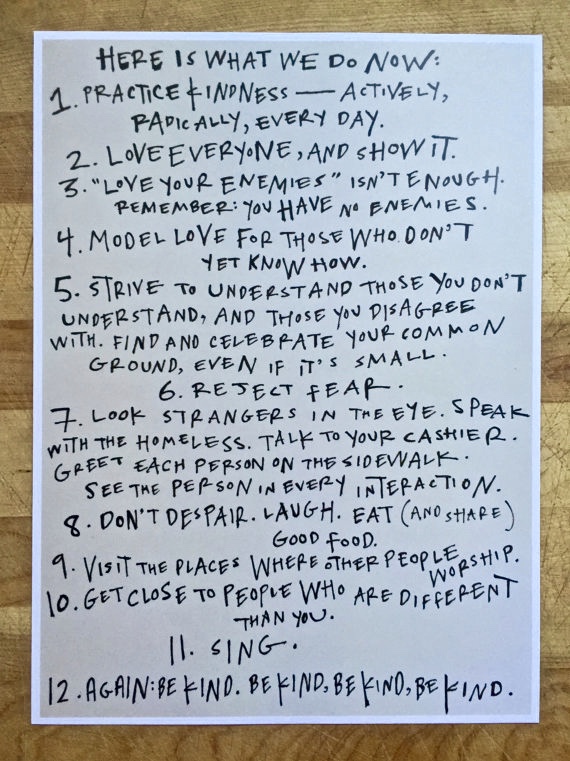
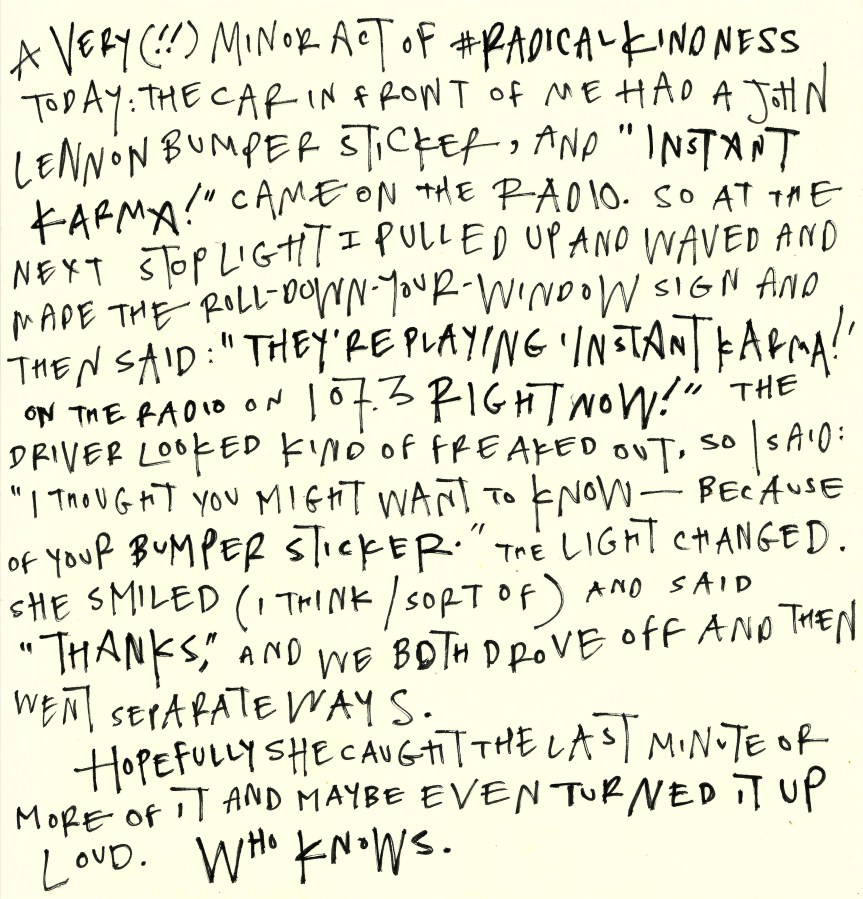
4. Last Saturday, a friend initiated #radicalkindnessday, encouraging anyone to devote their day to performing acts of radical kindness, however small or large. And people all over the country wrote in on Facebook to say what sorts of things they’d been doing, and what sorts of reactions they were getting.

It’s desperately important that this not be an annual or one-time event. Find a day in the next week to devote to radical kindness. And try to commit some such act of kindness — creatively and purposefully — every single day, from now on.

5. If you happen to live in or near Homewood, or if you ever use the post office on 18th Street, here’s a suggestion I’d like to offer as you consider your next act of #radicalkindness: send its staff some love. Bake them some Thanksgiving pie. Send them some love mail. Stand in their line, when you have no business to do, just to verbally declare your support.

Your kindnesses matter.

P.S. For what it’s worth, here’s what Glory, Norah, and I did last Saturday, on our first Day of Radical Kindness. (We enjoyed reading what others were up to — we read all the #radicalkindess posts to each other for inspiration — so I share our details here, in that spirit.) We gave out flowers and notes of encouragement at Railroad Park (the notes were Norah’s idea), baked brownies and cookies for our favorite convenience store owners, and bought doggie treats for the Humane Society. We still have a few more baked deliveries we didn’t have time to make, and a few letters we intend to write and mail; so several days later we’re still checking things off our ambitious list of weekend kindnesses — which is one way, I guess, to keep it going. Once we’ve checked them all off, we’ll make a new list.

To be clear, here’s the thing: we are overwhelmed. And we know (we do!) that cookies and flowers and dog treats aren’t going to stop white supremacy or hold an administration — and its most dangerous cheerleaders — accountable. Really, we know that. We are searching for bigger, real, political solutions and hope you are too (let us know what you got).

But/meanwhile/also:

a stranger at Railroad Park gave me a long, intense and wonderful hug after I handed her and her husband a flower. We introduced ourselves and talked for a moment and looked each other in the eye. Another young man told us, with a shaking voice: “I have been having a really hard time today, and this does help.” And I’d never seen the convenience store guys so excited as they were by this enormous delivery of sugar and butter. Nor have I heard the word “love” uttered so many times in the post office line. So all that, surely, is something. Baby steps, but something. And, anyway: if the alternative is despair, or complacency, or complicity, or never getting out of bed again — then for me the choice is clear.

Peace, everybody. Let’s all see what we can do.

*

Another P.S. The Day of Radical Kindness began as a Facebook event, thrown out to the world by Ally Wallen, just a few days after our presidential election. Here’s an excerpt from her proposal. Again, it’s a good plan for every week and weekend, and for every single day:

“I challenge us all to a day of radical kindness.

This Saturday, find a way to show radical kindness to your neighbors, friends, family, and strangers. Call your mom, buy a stranger a cup of coffee, reach out to someone that you know is afraid or feeling marginalized, send a friend some snail mail, volunteer, look people in the eyes and share a smile, connect with someone you disagree with, share a meal, send a prayer.

Imagine what we could do, as angry, afraid, disheartened as we may feel, if we choose to spread love and kindness as far and wide as possible. What could this day look like if we take all we feel and turn it in to tangible good?”

Thanks, Ally.

Let’s all get to work.


Everybody Eats When They Come To My House: The Lost Child’s Thanksgiving Leftovers

2021 UPDATE / EDIT: Here are four Lost Child Thanksgiving specials, great for streaming anytime during the Thanksgiving weekend, especially while cooking up a big meal:

Episode 457: 2021’s Thanksgiving Listener Gratitude Special: Listeners tell me what they’re grateful for, and I pick a song for each.

Episode 418: 2020’s Thanksgiving Listener Gratitude Special: Same deal, different year & gratitudes.

Thanksgiving Kitchen Playlist. 90 minutes of food songs created for the internet in 2016.

Episode 135: Everybody Eats When They Come to My House: A Thanksgiving Radio Special (75 minutes of food songs, with a few repeats from the kitchen playlist above — originally aired 2014)

… And here’s that original post:

As your holiday weekend winds its way down and you sift through your Thanksgiving leftovers, please make room for this final feast from my roots music radio show, The Lost Child: ninety minutes of food-themed songs to accompany your own holiday menu. The Lost Child’s Thanksgiving special is streamable anytime (and not just at Thanksgiving — you can save it as soundtrack for your next big day or night in the kitchen). Not a lot of turkey and dressing in the mix, but a lot of downhome soul food.

There are plenty of highlights here. The Bad Livers provide a funky banjo reworking of an old tune, “Crow Black Chicken,” an ode to chicken pie first recorded in 1928 by Mississippi’s Leake County Revelers and later revived by the New Lost City Ramblers (“Easiest work ever I done,” the lyrics confess, “was eating that chicken pie”). There are two numbers from the great, hilarious, ever-eccentric Andre Williams: first witness his desperate attempt to get his hands on some biscuits, and later revel in his extraordinary celebration of “Pig Snoots.” “‘Cued po’k sho is good po’k,” his Natural Bridge Bunch proclaims in that latter tune, and Williams announces his tireless dedication to that fact: “Aint got no sandals, put on my boots / Come all the way across town to get me some snoots.”

Then there’s the Carolina Sunshine Trio, from a broadcast over radio station WPAQ (Mount Airy, NC), offering this happy picture of romance: “Cornbread and butterbeans, and you across the table / Eatin’ beans and makin’ love as long as I am able.”

Joe Penny, an early alum of Hank Williams’ Drifting Cowboys, likewise offers in “Southern Fried Loving” a mix of appetites both gustatory and romantic, providing his own recipe for love: “I like my lovin’,” he sings, “just like my chicken / Heat it up until it starts to fry / Then add the seas’ning and starting cooking / That’s how you make lovin’, Southern-fried.”

Bessie Smith delves into full-fledged double-entrendre with her “Kitchen Man”: “How that boy can open clams,” she proclaims of her multi-talented personal chef: “No one else can touch my ham…” Other cooks, though, are less monogamous: see, for example, Roy Dunn’s lament, “She Cooks Cornbread for her Husband (And Biscuits for her Back Door Man).”

Some singers and musicians are narrowly focused on their favorite menu items: see Louis Jordan’s “Cole Slaw” or fiddler Joe Thompson’s lively, delightful “Pumpkin Pie.” The Maddox Brothers and Rose are smitten with “Fried Potatoes”; Baby Little and the Heartbreakers eat nothing but “Neck Bones Every Day.” And speaking of neck bones — in “Cracklin’ Bread,” Ed Baron turns hard times and a thin wallet into a triumphant menu: “Gonna serve some beans and neck bones,” he sings, “so we can carry on!” Still other artists celebrate the whole range of southern foods: Rufus Thomas, the Soul Sisters, and “Stick” McGhee all run down their own litanies of downhome fare. And Cab Calloway offers the ultimate tune for the Thanksgiving table, “Everybody Eats When They Come To My House.” “Have a banana, Hannah; try the salami, Tommy” — Cab has got something for everyone, and it all comes too with the cook’s classic admonishment: “Work my hands to the bone in the kitchen alone — you’re gonna eat if it kills you.”

Anyway, tune in here, and enjoy. Happy leftovers to you and yours. Be sure to share your bounty.

Picturing the Lost Child: A Few Drawings & Posters

Since 2012, I’ve hosted a roots music radio show called The Lost Child. To promote my Woody Guthrie centennial show that year, I drew my first Lost Child poster; I’ve done several others since then. This has gotten me back into the habit of drawing, a habit I’d abandoned for more than a decade. Here are a few posters I’ve done for The Lost Child, including the most recent: the Leon show aired last Saturday and the Pete show airs this Saturday. Click any image to enlarge it. I’ll post more of these here in the future. And my next blog post — or, anyway, one of the next — is about how I stopped drawing pictures, and how I started again.

I’m grateful to friends who’ve encouraged me to draw more pictures and make more posters in these last few years. At their encouragement, I’ve made prints of some of these for sale on my Etsy store — and I hope to host my first art show in a few months.

Stay tuned.

Happy Thanksgiving: The First Post

So, I’m going to give this blog thing a shot.

If you’re reading this very fist post, there’s a good chance we know each other. If so, you can skip the next paragraph. If not:

I live in Birmingham, Alabama, and teach high school English. I host a radio show, The Lost Child, an hour of downhome roots music, broadly defined—classic country, rhythm and blues, old-time string bands, southern soul, gospel, rockabilly, bluegrass and more—airing weekly on Birmingham Mountain Radio and on Radio Free Nashville. I write, mostly about music: my book Doc (2012) tells the story of an Alabama jazz hero, Frank “Doc” Adams, and my current book-in-progress is a larger history of Birmingham jazz. I’ve also produced a number of little homemade publications as the creator of Lady Muleskinner Press. There’s more about me and these projects and more on the “About” page.

I decided, a little suddenly, to start this blog: partly to bring together my creative projects in a single place, partly to let myself write a little less formally about things I want to write about, to exercise some different writing muscles than my current book allows.

One purpose of this blog is to share, behind the scenes, some pieces of the process of writing that book. For too long now I realize I’ve been working in total isolation: I’ve occasionally asked a friend for feedback and gotten it, but mostly I’ve been massaging draft after draft after draft of this thing, all on my own, sinking more hours than I can possibly count into a project I sometimes worry no one will see. With the blog I get to go a little more public with the project: to update readers on the process as it unfolds; to share interesting discoveries and asides from my research and writing; to explain why I think this story’s so valuable, why I consider it worth all the time and effort I’ve been giving it.

Just as much as all that, though, the blog will give me (I hope) a little happy distance from the book, freeing me up to write down words without the pressure of publication or relevance hanging over my head, letting me dip in and out of topics and interests I might not usually find a place to pursue. Most of the public writing I’ve done since college has been about music and history; I worry sometimes that I’ve forgotten how to write about other things — including myself. So one purpose of the blog is to help me remember how to write all the time, to write from experience and from feeling, to write for the pleasure of writing itself, and to shake off the restrictions and confinements I’ve slowly built up around my writing. The unknown territory of all that is scary to me. I don’t like to be that vulnerable or public and, though I host a radio show every week and want my words to be read by friends and by strangers, I sincerely don’t like to ask for attention.

But here goes.

You can expect here also lots of quick updates on what I’m working on—radio, drawing, teaching, etc.—and what I’m reading and thinking about.

And this, too: like a lot of people, I am sick, sad, and terrified over much of what I see in our country right now. I’m struggling to make sense of just what this moment means and asks of us, struggling to determine how I might act, to understand what these last few weeks demand of me, in the immediate present and for the rest of my life. All that takes some processing, and I imagine some small part of that will go on on this page, too. Two of my first posts, coming soon, are responses I’ve written to the last couple of weeks, trying to make sense of our moment.

In short, I expect this blog to cover a lot of territory, to focus on writing and radio but to jump around too. I hope you’ll come back often for updates. You can even click the “Follow” button on the sidebar on the right, if you’d like to get email updates. I won’t flood your inbox.

I’m writing this on Thanksgiving morning in Kentucky, so let me wish a happy Thanksgiving to you. May you be thankful for all the good in your life—the obvious goods and the goods sometimes overlooked—and may you find ways to share your bounty, today and every day.

Thanks for reading.

Burgin