The Birmingham Sessions

img_3760

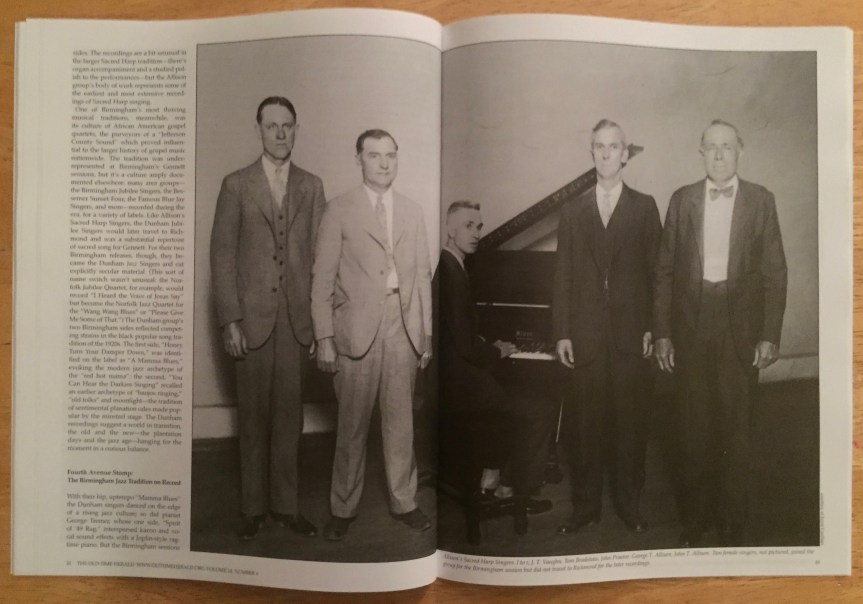
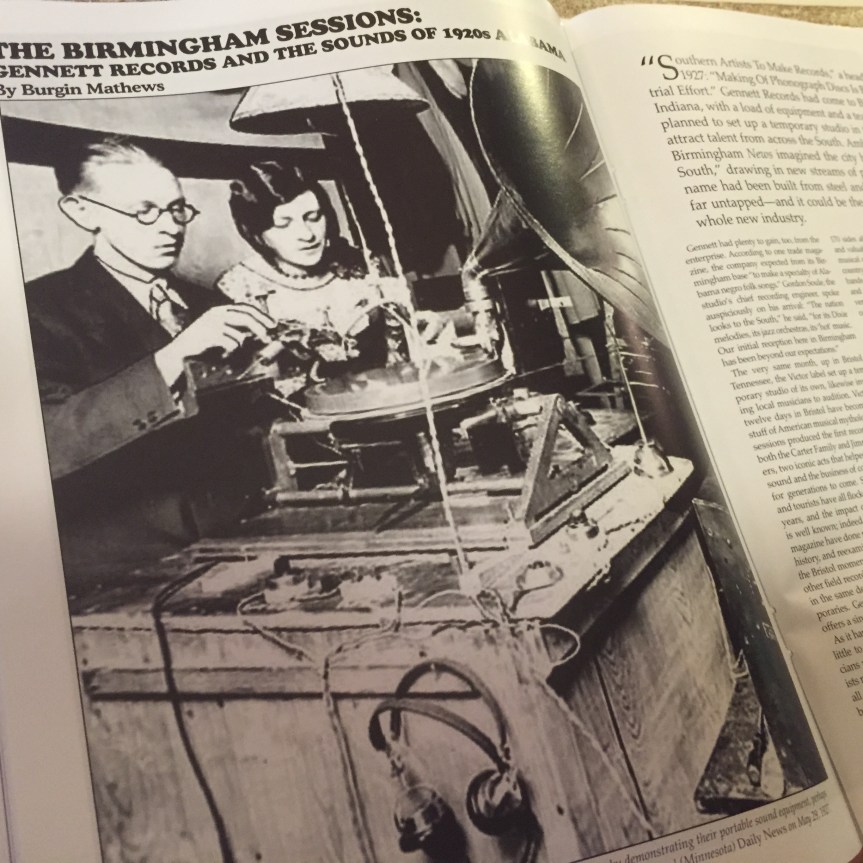
I’ve got an article in this month’s issue of The Old-Time Herald exploring Gennett Records’ 1927 trip to Birmingham. For two months the label set up shop in the Starr Piano store and waxed records of all sorts of local music makers: blues musicians, old-time string bands, jazz bands, Sacred Harp singers, society dance orchestras, gospel quartets, and more. The records, seldom heard today, offer a kind of cross section and time capsule of Alabama music as it sounded 90 years ago. My article dives into the specifics of these Birmingham sessions, placing them in the context of other “location recording” expeditions of the era—and takes a look at the many performers who came to the Starr store to record.

For many years, The Old-Time Herald has documented both the history and contemporary state of old-time string band music and other related traditions.They make room for long articles like this one, and they take great care with their photos and illustrations—as you can see in the spreads below. My article on the Birmingham sessions is a much-expanded version of a piece I published last summer in Birmingham magazine.

A quick excerpt follows. To read the whole thing, subscribe to the OTH. Thanks to the magazine’s editor, Sarah Bryan, for all her help—and to Joyce Cauthen for loaning some great photos, like the two below.

img_3761img_3763

From “The Birmingham Sessions: Gennett Records and the Sounds of 1920s Alabama”:

“Southern Artists To Make Records,” a headline announced in July of 1927: “Making Of Phonograph Discs Is Birmingham’s Latest Industrial Effort.” Gennett Records had come to Birmingham from Richmond, Indiana, with a load of equipment and a team of engineers. The company planned to set up a temporary studio in the Alabama city and hoped to attract talent from across the South. Ambitions were high all around. The Birmingham News imagined the city becoming “a musical center of the South,” drawing in new streams of profit and acclaim; in a town whose name had been built from steel and coal, music was a local resource so far untapped—and it could be the foundation, the papers imagined, of a whole new industry.

Gennett had plenty to gain, too, from the enterprise. According to one trade magazine, the company expected from its Birmingham base “to make a specialty of Alabama negro folk songs.” Gordon Soule, the studio’s chief recording engineer, spoke auspiciously on his arrival: “The nation looks to the South,” he said, “for its Dixie melodies, its jazz orchestras, its ‘hot’ music. Our initial reception here in Birmingham has been beyond our expectations.”

The very same month, up in Bristol, Tennessee, the Victor label set up a temporary studio of its own, likewise inviting local musicians to audition. Victor’s twelve days in Bristol have become the stuff of American musical mythology: the sessions produced the first recordings of both the Carter Family and Jimmie Rodgers, two iconic acts that helped shape the sound and the business of country music for generations to come. Scholars, fans, and tourists have all flocked to Bristol for years, and the impact of those sessions is well known […] Less familiar are the other field recording sessions conducted, in the same decade, by Victor’s contemporaries. Gennett’s trip to Birmingham offers a single case study.

As it happened, the Gennett sessions did little to advance the careers of the musicians who participated; most of these artists never recorded again. Birmingham, for all the newspaper’s excitement, wasn’t reborn into a mighty music hub. There were no game-changing discoveries, no Carters or Rodgers as there were that summer in Bristol. But the recordings made in Birmingham that July and August—nearly 170 sides altogether—represent a unique and valuable cross-section of the region’s musical culture. There are jazz bands and country blues singers, old-time string bands, gospel quartets, a ragtime pianist and singers of the Sacred Harp—a rich diversity of local sounds, all testament to a community steeped in music….

A Valentine’s Playlist, Part Two: Post-Love Songs

Birmingham magazine asked me to create a Valentine’s playlist for their February issue. I submitted ten love songs and, for good measure, a few musical tributes to romances lost. A few days ago I posted here an expanded and annotated version of that first list, the love songs; the bonus tracks, the breakup tracks, follow.

A quick distinction: there are plenty of angry and bitter breakup songs in the world, but those aren’t the ones I wanted for this list. At least a couple of these are love songs in their own right, even if the romance behind them is over. These aren’t wallowing songs or spite songs, or songs spat between bared teeth. There’s pain and loss in this list, but there’s also the peace of letting go, and there’s the love that still lingers after love. I’m a great fan of post-love songs like these. I think they are things of beauty.

1. Bob Dylan, “Sara”

“Sara” is a Valentine to a marriage that finally fell apart, and even if its subject is divorce it’s one of the greatest love songs I can think of. It’s so vividly specific and so remarkably personal, it feels like we’re watching home movie footage, or rummaging through a family’s box of old slides, holding each for a moment to the light. It’s also got one of my favorite details from a Bob Dylan song: “Staying up for days in the Chelsea Hotel, writing ‘Sad-Eyed Lady of the Lowlands’ for you.”

I can’t post a link since there’s no Dylan on Youtube, but if you don’t already have the album Desire, you should go ahead and get it; or if you’ve got it and haven’t played this song in a while, why not put it on now?

2. Dolly Parton, “I Will Always Love You”

I’ve never much cared for Whitney Houston’s sprawling, over-the-top, smash-hit version of this song, the version most people think of first. But Dolly Parton’s original, written for her mentor and boss Porter Wagoner, just kills me every time. Dolly and Porter’s breakup was a professional and creative one: she’d gotten her start on his TV show and been his duet partner for seven years, but she was ready now to move on. Porter had made Dolly a star, and her rising success had helped bolster his own career. With this song, she told him goodbye.

With or without the back story, it’s a beautiful and inspiring song. What if all of us were this good at breaking up? What if all of us had so much grace?

P.S. The clip above comes from an episode of The Porter Wagoner Show in 1974. “You sing it just sort of like you mean it, too,” Porter says afterwards, a little awkwardly. “Well, I did mean it,” says Dolly.

3. Cat Power, “Empty Shell”

Outside of Neruda, I don’t know any post-relationship poetry better than the simple, honest, unexpected lyrics of this song.

I love you
And I miss you too
I really do love you
And I really miss you too
But
I don’t know you
And I don’t need you
And I don’t want you
anymore

There’s also a good country fiddle on this one.

4. John Prine, “All the Best”

John Prine’s ex-wife asked him to sing at her next wedding. And so he wrote and sang this song:

I wish you love, and happiness
I guess I wish you all the best

“I guess.” It goes on:

 I wish you don’t do like I do
And ever fall in love with someone like you
Cause if you feel just like I did
You’d probably walk around the block like a little kid
But kids don’t know. They can only guess
How hard it is
To wish you happiness.

If you’re John Prine’s ex, and you ask him to sing at your wedding, I’m sure you know what you’re in for. It’s not one of Prine’s greatest songs—that’s a very high bar—but it’s full of Prine’s pointed, sweet, melancholy, funny simplicity, and full of warm and unexpected beauty. “Yeah, I knew love,” Prine sings, “and love knew me”:

And when I walked, love walked with me
And I got no hate, and I got no pride
Well, I got so much love that I cannot hide
Yeah, I got so much love that I cannot hide 

Happy Valentine’s Day, everybody.

*

P.S. What are your favorite post-love love songs? I invite you to post them in the comments below—even if they are the mean or wallowing kind. First, here are a couple of real old ones, two more of my favorites. In both, a full-sentence title matter-of-factly says it all: “I truly understand you love another man”; “I loved you better than you knew.” Read the magnificent biography of the Carter Family, Will You Miss Me When I’m Gone?, for some heartbreaking context for the latter tune: that A. P. and Sara Carter were newly separated when they recorded this one is only part of the story. That they’d record so many more songs together for a decade to come—even after their divorce, even when they couldn’t bring themselves to speak between takes—is, too, only part of the story. That the lyrics echo (and portend) so many truths of the singers’ own hearts makes the song only all the more powerful.

As for “I Truly Understand”: The New Lost City Ramblers brought this one to a new generation in the 1950s and ’60s; David Grisman and Jerry Garcia have recorded it since then, and others have too. I’m thankful these fine artists have helped keep the song alive, but the later versions all strip from the song the archaic weirdness of the original. Without the sudden bleating harmonies of the children, it’s just not the same.

True Love & Broken Hearts: A Valentine’s Playlist, Part One

For this month’s issue of Birmingham magazine I compiled a short Valentine’s playlist, “True Love (& Broken Hearts).” I thought I’d expand on that list here with a few notes on each song, plus links and a couple of bonus tracks. The Lost Child’s annual Valentine’s special, “50 Cents of Gas & a Country Road” airs on Birmingham Mountain Radio tomorrow morning, and we’ll expand the playlist further on the air.

Valentines Day, of course, doesn’t spell joy for everyone. So my playlist ends with a bonus break-up playlist: bittersweet anthems to romances broken. I’ll post those tunes here—again, with commentary and links—in a few days.

First, the love songs. This list could be expanded infinitely (isn’t that wonderful?), and I don’t pretend these are the greatest love songs of all time (although a few of them are). But these were a few of the first that came to my mind, and they include some staples of my annual special.

1. Bob Dylan: “Never Say Goodbye”

Dylan’s reinvention of himself up in Woodstock, New York, resulted in a genuine sweetness and fireside hominess that was new to his work. I don’t know that Dylan shows up on a lot of Valentine’s playlists, but maybe he should: albums like New Morning and Planet Waves are warm and wonderful testaments to marriage, family, and home—and tracks like this one and “Wedding Song,” both from Planet Waves, offer a sort of straightforward love song that goes often overlooked in Dylan’s catalogue. (Since there’s no Dylan on Youtube, there’s no link for this one—but you should own the album.)

2. Sam Cooke: “You Send Me” (demo)

There is so little to this song, on paper, that there’s almost nothing there: six or seven words repeated over and over again, and a bridge. But with “You Send Me” Sam Cooke made clear just how much he could do with just how little, how he could build an entire song out of air—out of hums and fluttering whoa-oas, out of stretched-out vowels and simple, beautiful repetition. “You Send Me” was Cooke’s debut as a solo, secular singer (he was a gospel sensation already), and it launched him to pop stardom.

The song’s original demo is a beautiful behind-the-scenes revelation—just a voice and a guitar, and a masterpiece of simplicity.

3. Juanita Rogers: “Love Letter Full of Promises” (demo)

Another demo, and another joy. The single that resulted from this session—“Teenager’s Letter of Promises,” by Juanita Rogers and Lynn Hollings, with Mr. V’s Five Joys—appeared on the Pink Clouds label in 1958. It was produced in Chicago by Sun Ra, and the record certainly has Sun Ra’s stamp: it’s a teenage lover’s lament, framed by eerie doo-wop harmonies and an echoey voice-of-God, Ed Woodian narration. Even with a bubblegum ballad, Sun Ra didn’t go in for predictable pop conventions.

Listen to Juanita’s a cappella demo and hear the song stripped down to nothing but pure vocals and feeling. Whatever happened to Juanita Rogers? I don’t know, but her one demo’s a tiny, heart-melting miracle.

4. Drive-By Truckers: “Love Like This”

Another sort of love song, for another sort of love. I consider this one of the greatest country songs ever written.

5. Aretha Franklin: I Never Loved a Man (The Way I Love You)

This song, which I first heard in high school, probably started my love affair with soul. Recorded in Muscle Shoals in 1967, it was the first record Aretha made for the Atlantic label, and in the first few seconds of the song she announced herself mightily, unmistakably to the world. Every time you play it, she does it again.

I don’t have much else to say about this one. It’s a perfect record.

6. Karen Dalton: “Take Me”

“Take me to your nearest room; close every window, and bolt every door.” It was a George Jones song first, written with Leon “Lost Highway” Payne; Jones recorded it on his own and again later as a duet with Tammy Wynette, the first of their classic recordings together. But there’s nothing I like more than the way Karen Dalton’s unmistakable voice wraps around, turns over, slinks through, stretches out and bends these lyrics into a thing of her own making. “Take me to Siberia,” she sings, and she moves up and down the next phrase like a staircase: “in-the cold-est wea-ther of-the win-ter time…” It’s a great pairing of song and artist, the thoughtful, unconventional lyrics matched by Dalton’s otherworldly voice, full at once of sweetness and pain. (Kudos to those songwriters, by the way, for filling a country love song with such unlikely images and associations: a barren desert; a bolted door; Siberia.) “It would be just like spring in California,” the song concludes, “the day you say you’ll be mine.”

“Spring in California”—what a wonderful combination of words.

7. Elmore James: “It Hurts Me Too”

“When things go wrong, so wrong, with you—don’t you know it hurts me too?”

Sam and Dave had a similar refrain: “When something is wrong with my baby, something is wrong with me.”

The rest of the lyrics, it turns out, aren’t as purely romantic as the refrain might suggest—I honestly just listened to them, now, for the first time. But, like I said before, Valentines Day isn’t always easy. And how about that scorching electric guitar?

P.S. Speaking of Bob Dylan and Karen Dalton, check out their versions of this song, too—and the original recording, by Tampa Red.

8. Hoagy Carmichael: Stardust

Several songs on this list have been covered widely, but none as frequently as this staple. It’s hard to beat Louis Amstrong’s version, but there are so many outstanding renditions to choose from. I’m in love with this spare little rendition by the song’s composer, the great Hoagy Carmichael. Usually we hear other people do his songs (this one and “Georgia on My Mind” and others). It’s nice to hear his own take on “Stardust,” from 1942: unaffected, laid back, and totally sincere.

I couldn’t be any happier when he starts whistling.

9. Clarence Carter: Making Love (At the Dark End of the Street)

“Dark End of the Street,” Dan Penn and Chips Moman’s anthem to illicit love, is for Clarence Carter just an afterthought in his “cover” of the tune: once he finally gets around to singing, more than four minutes into the record, we’re just seconds away from the fade-out. But it’s the build-up that makes this one count: this epic sermon on making love presents Clarence Carter as his fullest-fledged, most outrageous self. He is preacher, grade school teacher, and sultry-voiced love doctor all in one—but it’s Clarence Carter as comedian who’s at the heart of this record. The singer, famous for his boisterous and smutty “heh-heh-heh,” clearly delights in his own sense of humor. Every year I play this song somewhere near the climax of my Valentine’s Special. In fact, the name of this annual show—“50 Cents of Gas and a Country Road”—comes from Carter’s monologue.

Years later, Clarence Carter would record “Strokin’” as a kind of sequel to this, his last big hit (to date). You might think from these that Clarence Carter is only good for a laugh, but don’t be fooled: try “I Can’t See Myself (Crying About You)” or “Don’t Make My Baby Cry” for straight-ahead, straight-faced soul. And if you want to hear “Dark End of the Street” without the sermon, try James Carr’s definitive original, or Aretha’s gospel tour de force—or the Flying Burrito Brothers’ country rock revision.

10. The Blue Ridge Mountain Singers, “I’ll Remember You Love in My Prayers”

This old parlor tune dates back to 1869. Its original title is “When the Curtains of Night are Pinned Back” and it has lyrics like this:

     When the curtains of night are pinned back by the stars
     And the beautiful moon lights the sky
     When the dew drops of heaven are kissing the rose
     It is then that my memories fly.

The Blue Ridge Mountain Singers recorded it in 1930.

I am smitten with this record.

11. Dan Reeder, “Clean Elvis”

    … I grab my laser gun, I know my place:
     Somebody has to save the human race.
     And I-I-I
     will always love you.

As far as I’m concerned, this one has it all: Dolly Parton, Elvis Presley, and sci-fi, all wrapped into a single (sort of) love song.

12. June Carter Cash and Johnny Cash: The Far Side Banks of Jordan

This one, though, is the kicker.

No one expected Johnny Cash to outlive June, but still somehow he did. June Carter Cash died in May of 2003; Johnny followed five months later. In the brief window between their deaths I drove through the little community of Hiltons, Virginia, the Carter Family’s longtime homeplace, a rolling country town where the Carters and Cash still had deep roots. I stopped at the little museum at the Carter Family Fold, and there was grief all around. A sign in a church yard read simply, “PRAY FOR JOHN.” And soon he too was gone.

Johnny and June first cut this song, “The Far Side Banks of Jordan,” back in the seventies, and they grew old with it between them.For June’s 1999 album Press On they recorded it a last time. The words and music came an English teacher and country songwriter named Terry Smith, but the song feels like it’s made just for these two. “I believe my steps are growing wearier each day,” John begins, and the weariness in his voice is real: “got another journey on my mind…”

     Lures of this old world have ceased to make me want to stay
     and my one regret is leaving you behind.

Then June picks it up:

     But if somehow it proves to be His will that I am first to cross
     And somehow I have a feeling it will be
     When it comes your time to travel, likewise don’t feel lost
And I will be the first one that you see

It goes on from there but, suffice to say, all the others on this list are lightweights by comparison.

Rest in peace, John and June. And may we all grow into loves like this one.

Fake News In The Classroom: One Teacher’s Experience

A few weeks ago I asked teacher friends on Facebook how they might approach the topic of “fake news” in their classrooms. A lot of friends responded, teachers and non-teachers alike, and I cobbled together their ideas into a last-minute lesson plan. The following post is mostly for teachers, or for those with an interest in how we navigate the so-called “post-truth” world—and how we teach it. It’s a long post. But I encourage teachers to use whatever is helpful here, and I welcome feedback (not just from teachers) on how to most effectively and impartially navigate this territory.

This isn’t written out as a conventional lesson plan, but here’s my sequence of activities, handouts, etc., with reflections along the way on how it all went for me.

A troubling note: in some ways this lesson is already outdated. When I introduced this lesson, most of my students had not heard the term “fake news”; within a week, our president elect labeled CNN “fake news” in a press conference, and since then his administration has frequently thrown that phrase at reputable, fact-based news outlets. Since I put this lesson together, the conversation about fake news has already shifted and is still evolving. In the meantime, it’s only more and more important that students be given tools for sifting through facts, bias, and outright fakery. So this—with the help of many friends and resources—is my first stab at that.

Background:

Back in August, in the first week of our first semester this year, my class started with icebreakers. After that, the first substantive thing we did was watch a TED Talk: Eli Pariser’s discussion of “filter bubbles.” This is a great video to watch with students, and I was surprised by how surprised they all were at this concept. I showed them The Wall Street Journal’s Red Feed, Blue Feed experiment, and we discussed the ways in which our interactions with current events is curated (by algorithms!) to fit our apparent biases. We also looked at how different headlines promoted different interpretations of the same news story, and considered how our online experience of the news can work to distort our perception of events and reinforce our biases.

I was upfront about the the objectives of this lesson. I told students I wanted them to:

+ be informed consumers of media—to be on the lookout for implicit bias and manipulation

 + seek out differences of opinion than their own—to expose themselves to, and truly listen to, the opinions of those they might disagree with

+ first assemble the facts, then form their own opinions—to think for themselves, rather than just internalize and parrot the opinions fed to them by their feeds (or by their parents or friends or their news source of choice)

That was the first week of our first semester.

*

I didn’t decide to tackle “fake news” until the night before our second semester started. I don’t think about school very much over the holidays. But suddenly I thought it would be very timely—and would give perfect symmetry to our year—if we started Semester Two with a new round of icebreakers, and then with a new look at how we receive our news. Instead of talking about news bias, filter bubbles, and manipulative headlines, this time we’d talk about the “news” that isn’t even based in fact.

I had no idea how to teach this. And I’d run out of icebreakers. So the night before school started back I asked Facebook for icebreaker tips, and I got a million of them. The next night I asked for help in teaching fake news:
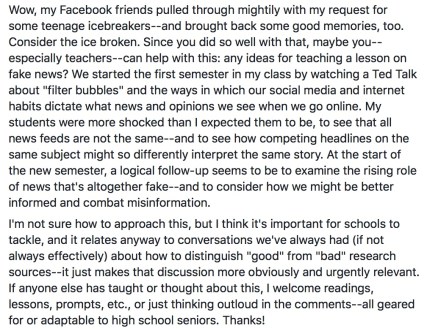
fb-fake-news-post

I went to bed and woke up very, very early. And, with the help of my friends, I put together a lesson that worked remarkably well. This, adapted from my notes that morning, is what we did:

1. Intro:

I remind students of the conversation that started the year, about filter bubbles. I remind them of why we talked about that to begin with (to make ourselves better informed, to seek out a diversity of opinions, to form our own opinions for ourselves). But, I say, one thing we didn’t talk about was this: how do you even know the news is real? We can argue about the interpretation of facts, but how can we be sure we’re discussing facts to begin with?

Since we talked in August (I said), the subject of fake news has become an increasingly important, and much-discussed, topic.

So: here are five headlines from the last few months. Which ones, if any, do you think are reporting facts?

2. Pope Headlines:

I put five Pope-related headlines on the projector. I tell students that all five circulated the internet widely sometime in the last year (which is true). I hand out notecards. I tell them to identify which headline, if any, is factually true. It might be zero. It can’t be all five—they contradict each other—but it could conceivably be as many as three. Then, on their notecards, they have to briefly explain how they made their decisions.

Here are the headlines:

A. Pope Francis Endorses Bernie Sanders for President
Sources: National ReportUSAToday.com.co

B. Pope Francis Shocks World, Endorses Donald Trump for President, Releases Statement
Source: WTOE 5 News

C. Pope Benedict XVI Forbids Catholics From Voting for Hillary!
Source: Tell Me Now

D. Pope Francis Shocks World, Endorses Hillary Clinton for President, Releases Statement
Source: KYPO 6 News

E. The Pope Says Spreading Fake News is Like a Fetish for Poop
Source: Qz.com:

I take up the notecards (and they’re fascinating—this lesson is already going better than I expected). After looking through the cards I tell students the results, but don’t tell them the answer: only one (out of 20) students got it exactly right. Only one of the headlines reported a fact; and only one student correctly identified the real story without also being duped by other fake ones. I tell them, too, that the most common answer was guessed by 11 students—but was wrong.

I tell them to hold that thought, that we’ll get back to the answer.

3. Chart: Fake News Outperforms the Real

Then I show them this chart.

BuzzFeed’s Craig Silverman calculated which news stories—that is, fact-based news stories—received the most engagements on Facebook in the months leading up to the presidential election: which stories received the most clicks, likes, and shares. He did the same for “fake” news stories, reports whose most basic details were objectively false. Looking at the top twenty stories from both categories, he compared which got shared more, the real stories or the fake ones. Look at the chart for yourself. But, in summary: as the election approached, the top 20 fake stories were shared more and more—until, finally, the top 20 fake stories received more Facebook engagements than the top 20 real news stories.

There are, by the way, some issues with this chart, and I indicated my questions and concerns to my students, too. Most of the fake stories showed a pro-Trump bias, while many of the real stories, though reporting facts, carried an obvious anti-Trump bias of their own. The difference was that while some of the “real” stories were clearly slanted—with inflammatory headlines or an overall liberal voice, the sorts of biases we’d discussed last semester—the “fake” stories reported outright lies as truth. I again encourage my students to seek out unbiased reporting—or at least to know how to critically recognize bias—but I suggest there’s a difference between bias and outright untruth. While I may have minor reservations about Silverman’s methodology, his findings are certainly reason enough for concern, indicating the widespread presence of fake news in our culture.

4. Pizzagate

Then we talk about “Pizzagate.” Only one of my students had heard of this. So I give quick background and show this video. There are probably better clips than this, but any reporting on the Pizzagate gunman will get the point across: that motivated by an unfounded news story, a gunman walked into a pizzeria to wreak his vengeance. Fortunately no one was hurt, but students immediately recognize that fake news can have real world consequences. I add that a pizza restaurant in Texas has also suffered harassment for its alleged, utterly unfounded involvement in the Pizzagate scandal.

5. How False News Can Spread

Then I show this video. It’s not so much about what we’ve come to call “fake news” (Pizzagate, etc.), but about how even well-intentioned news sources can get the news wrong.

6. The Pope, Part Two

Now, back to the Pope. (We went pretty quickly through all these items, so it’s only been about 15 minutes since the Pope teaser.) The answer, of course, is that only item E is correct: “The Pope Says Spreading Fake News is Like a Fetish for Poop.” Again, only one person guessed this and only this answer. About three people guessed this answer at all, but the others also guessed a false headline was real.

(As a fascinating aside: 11 students out of 20 guessed that this was the real headline: “Pope Francis Endorses Bernie Sanders for President.” On the whole, students in this class are fairly conservative; several voted in November for the first time, and voted for Trump. But a few wrote as explanation for the Bernie headline—“It just seems like the most believable/plausible headline.”

Those who accurately guessed the “poop” headline, incidentally, all said something along these lines, in explaining their choice: “You just don’t make that up.” Some who rejected the poop story as false offered essentially the same explanation as grounds for disbelief: “That one’s just too bizarre to be real.”)

For kicks, I share with them multiple headlines from the poop quote, to show how different writers will emphasize different elements of a story, even if all are reporting the same facts. So, a few related headlines:

Pope Francis compares fake news consumption to eating feces | The Guardian, Newsweek

Pope Francis compares consuming fake news to eating excrement | Sydney [Australia] Morning Herald

Pope Francis says spreading fake news is a sin | New York Post

Pope Francis compares media focus on scandals to fecal fetish | USA Today

Pope Francis: People Who Report Fake News Are Like Those Who Eat Poop | The Christian Post

Pope Francis: Fake news is like getting sexually aroused by faeces | The Independent

Why the Pope Compares Fake News to Sh*t; Its Readers to Sh*t Eaters | Daily Beast

Did Pope Francis Liken the Spread of Fake News to Taking Pleasure in Poop? | US News and World Report

I also share the Pope’s actual quote, so they can choose for themselves the best way to report the story: “I believe that the media should be very clear, very transparent, and not fall prey—without offence, please—to the sickness of coprophilia, which is always wanting to communicate scandal, to communicate ugly things, even though they may be true,” he said. “And since people have a tendency towards the sickness of coprophagia, it can do great harm.”

The victim of many fake news stories, it’s no surprise the Pope would speak out against it—even if his analogy is pretty bizarre.

One other important point about all this: for each of the original headlines, as indicated above, I indicated one or more source. A few of my students were savvy enough to take those source names into consideration in determining what was real—but those students still got the answer wrong. Some said they chose the Bernie headline not just because he seemed the most Pope-friendly candidate, but because the sources listed—National ReportUSAToday.com.co—“sound legit.” “Those sources sound familiar,” someone wrote. And this, we discuss, brings up an essential point in vetting your sources: National Report sounds real, but is somebody’s blog, made to look like a news source. You have heard of USA Today; but usatoday.com.co is not usatoday.com. Fake news sites will do their best to appear legitimate, so you’ve got to be sure you don’t let their names fool you.

Other students, meanwhile, said that these sources—WTOE 5 News and KYPO 6 News—sounded like legitimate news sites. Again, this allows us to discuss vetting our sources: the fakers are deliberately, and easily, making up local news stations that will sound real but aren’t. You have to dig beneath the surface to find out whether you can trust it—but a random “local” news network you’ve never heard of should invite suspicion.

Lastly, I’ll admit to one deliberate sneaky trick. Many reputable news sources reported the Pope/poop story, but I sourced a more marginal site (qz.com) that I figured none of my students had heard of (neither had I), and whose very name I thought might invite mistrust. Again, a couple of savvy students—who fell for usa.com.co, because it sounded legit—wrote that they rejected the poop story because qz.com sounded illegitimate. This quick activity, then, offered several good opportunities to discuss the challenges of deciding what sources we can trust—what pitfalls to avoid, and how to confirm a source is reporting real news.

7. BBC quiz:

Then students take this quiz—and briefly discuss the results. I mention how absolutely I failed this quiz. (This quiz, I tell students, is another good reminder of the pervasiveness of fake news online—but it’s only so useful or telling in itself, since the headlines are totally out of context here. As we’ve already discussed plenty by now in this and last semester’s lesson, you have to go beneath the headlines and examine broader contexts. Still, this or similar online quizzes (there are several) can at least reinforce the simple truth that there’s a lot of fake news out there, and that it’s up to you to be wary.)

8. Survey

Finally, students take a survey (real-vs-fake-news-survey), about their own online habits. Please note, the survey comes from the New York Times’ “The Learning Network” blog, almost verbatim. I reworded or cut a few questions to fit my classroom. You can find the original text—and many other useful resources—here.

This was a lot for a single period, but we did manage to do it all. I had to be much more careful than usual to move the class at a quick pace, but I think the variety of activities and the quick pace made it more interesting—and still allowed for pretty eye-opening conversations along the way.

*

A Few Days Later…

Later that week, I came in with an embarrassing confession. It was embarrassing for me, first, to admit to my students that I’d shared a cheesy, fluffy, celebrity-gossipy, feel-good article at all online in the first place, something I almost never do (I actually avoid sharing articles in Facebook in general, though I do read plenty). But it was doubly embarrassing to have shared a cheesy, fluffy, totally fake story, at that—and the very same week that I was teaching my students about how to recognize fake news.

It’s a really common fake news trope, too: Celebrity Has Nice Things To Say About Random Small Town. I’d even corrected somebody on Facebook for posting a similar fake story about Birmingham about a year ago. But recent weeks had battered at my defenses and senses, and I saw this innocuous but nice article about Bill Murray (who I like) and the town of Millbrook, Alabama (where I’ve often been), and it was the first positive story in my Facebook newsfeed in days, and so I re-posted it. Because Lord knows Alabama needs more positive stories.

On rereading it, it’s absurd. The story, in short, is this: that Bill Murray was driving a rental car through Alabama, and it broke down on the interstate outside of Millbrook (I know—I cannot explain how I fell for this). And so a local took him to a mechanic and while they waited took him out “to the finest dining spot in Millbrook—some place called Joe Mama’s,” where he got a burger. “Great freakin’ burger too.” And so Bill Murray had all these wonderful things to say about the good, salt-of-the-earth types—real people, not Hollywood fakes—who lived in Millbrook. And the best part: they didn’t even recognize him! (Because, one imagines, in Millbrook, Alabama, no one has ever seen Ghostbusters.)

And here’s the thing, and I told students this, too, when I confessed to them my Facebook sin: while I was reading it I thought to myself, why didn’t they take him to the Millbrook Smokehouse? But I went ahead and believed it anyway, and hit share.

Within five minutes a friend had commented that the story was fake, that indeed the exact story had been published, word for word, about multiple celebrities in multiple small towns.

I told my students all this in shame. So how, I asked, can you know if a story is fake? Then I did, with my students, what I should have done myself before I shared the story: I cut and pasted a quote from the article into a Google search, just to see what we could find—and, voilà:

“Hugh Jackman Said This About Windsor, Colorado Residents”

… and Adam Sandler about Billings, Montana

… and Bill Murray about Rochester, New York

… and Blake Shelton about New Albany, Indiana

… and Bill Murray about Toowoomba, Australia…

Exact same story, every time, just different celebrities and towns—and different restaurants, so locals will read it and believe (there is a Joe Mama’s in Millbrook, though I still doubt it’s finer than the Smokehouse). Our simple Google search also revealed multiple sites that identified this or that story as a hoax. This, I might add, is the same way I catch my students for plagiarism—a simple test that has caught more students through the years than I care to number. But I hadn’t taken the five easy seconds necessary to investigate this story before I hit “share.”

I told my students, attempting to regain a little pride, that I could have deleted my original post. But, as I’d seen modeled by other friends online, I posted an update and apology instead, and edited my original post to confess my mistake. Only after 24 hours, did I take down my original post.

It’s a stupid thing, but I thought it important to share with my kids: that—as a smart, informed consumer of media, and as someone who’s teaching students this week(!!) how to avoid fake news—even I was duped, that I temporarily abandoned my own standards for navigating the truth, simply because I wanted to spread some positive vibes. I told them how embarrassed I was, but I also explained my reasons for not deleting the post altogether. Sometimes we still might screw up. When we do, we have to own it.

Other fake news stories might help sway how we vote—or might send a lunatic into a pizza parlor with a gun. Thankfully my fake news story had no serious real world consequences: it was a silly, innocuous celebrity fluff piece that happened to be fake. But there are consequences for accepting lies, however innocuous they might be, as facts. We become uncritical in our thinking—in fact, we are not thinking at all—and we contribute to a culture where reality and facts no longer matter. And that’s scary.

A Few Days After That…

Later that week, in his first press conference since the election, the president elect publicly refused to acknowledge CNN, saying the network was “fake news.”

Since then, with repeated iteration of that claim, it’s become increasingly fashionable—from the White House on down—to label as “fake” any news source with which you disagree. So the fake news phenomenon has just become more complicated—for students, teachers, and any other citizens—than it already was.

Wrapping Up: A Resource foe Students

After I tell my Bill Murray story and acknowledge the president’s adoption of the “fake news” label, I present students with this handout: “Ten Questions for Fake News,” by the News Literacy Project. I recommend the handout to other teachers—it takes just a few minutes to go over, and there’s some good advice on it.

One Last Handout

Remember the survey that ended our first day’s lesson? One series of questions was this:

How much more careful are you with online sources when you are doing work for school than when you are simply surfing the web for fun? How do you decide what is a reliable source for your schoolwork? Do you use similar methods outside of school?

Universally—not at all surprisingly—students said that they are much more careful checking the reliability of sources for schoolwork than for sources they might engage outside of school. The most common explanation—again, not surprisingly: “In school, it’s for a grade.”

But a couple of students wrote, in effect, this: “Teachers show us how to choose reliable sources for schoolwork, but not for the news.” One student said: “We have a handout about how to choose scholarly sources for school, but we don’t have a handout for this.”

For me, this was one of the most profound discoveries of this lesson. I already suspected this: that we hammer home to students how to choose reliable sources when they research poetry or history, but we don’t have the same conversations about how to engage the immediate, day-to-day world around us. But this student’s comment, in all its helplessness—“We don’t have a handout for this!”—really made this failing sink in. And so I made a simple handout: what-do-you-know-about-these-news-sources.

All it is is a list of news media—online, in print, on TV or on the radio. There’s white space, so students can take a few notes on the different sources named; I won’t require students take notes on this, but I hope some of them will. Clearly, it’s far from exhaustive—I only name a few news magazines and news sites—but it’s a start. I wanted the size of the list to be manageable, and we could debate just what to include; if you teach this, you can tweak the list.

I passed out the handout and asked: what do you know about these sources? Which of these would you trust? Which would you not trust? Which would you trust, but with a grain of salt—or with the expectation of bias? When I introduced this in class, we only had a few minutes to discuss. One student said, “I wouldn’t use BuzzFeed for real news. It just doesn’t make sense to me to get important news from the same site where I take stupid quizzes like ‘Which Harry Potter Character Are You?’” I said I thought that was good logic and asked: What do you think is the purpose of a site like BuzzFeed? The consensus was “entertainment” and “to get more clicks.” That seemed like a good start to the conversation. Then the bell rang.

We haven’t had a chance to come back to this handout, but I plan to give it a quick second look with students next week, since most admitted to knowing nothing about most of these sources. I’ll give my own best, most objective descriptions of the sources and their reputations. The students will have to take it from there.

Postscript: Final Thoughts 

1. I already see, by the end of this lesson, my students throwing up their hands in despair and resigning themselves to this possible conclusion: there’s no way to know the truth anymore! You simply can’t trust the media! “This is scary,” a lot of them say, and some—to whom all this is new territory—look either helpless or hopeless. This, though, is the most important part of this lesson, and it needs to be reiterated more than once: that it’s increasingly hard to know the truth, but it’s more important than ever to seek it out. Giving up on the facts is simply not an option. You have to be vigilant and diligent, but you have to do it. We are neither helpless nor hopeless. It may be hard work and scary, but we have no choice but to do the work of being informed and committing ourselves to truth.

2. Here’s a topic for another conversation, but I’ll bring it up briefly here. The Trump era presents challenges for educators as well as journalists. As a public high school teacher, I’ve never discussed my own politics with students, even when we’ve discussed current events—which we’ve done a good deal over the years. I take this seriously.

I would love to hear from fellow teachers (in the comments below, via email, or in person): how you deal with the challenge of teacher neutrality in the new world of Trump? What if, in its first weekend in office, an administration lies about the size of its inaugural crowd? What if a president claims, without evidence, that nearly three million illegal votes were cast in the last election? What if a president suggests that real news organizations are “fake”? Putting aside (for the moment) every other concern that comes with this administration: how do you objectively discuss current events with your students, when the president makes wildly unbiased claims—and actually, actively lies? What happens when it’s perceived as partisan to simply point out a fact?

Are other teachers struggling with this? Where do you stand on these questions?

What do you do?

*

P.S. Thanks to multiple friends who shared their suggestions on Facebook; as I mentioned above, this lesson is entirely a pastiche of others’ ideas and work. Kate Harris—who has herself created outstanding, relevant lessons (like this!) for the New York Times—pointed me to the Digital Resource Center and the NYT‘s Learning Network. Heather Fann suggested the Pope activity, which was enormously successful and provoked great conversation. And William Davis quickly kindly pointed out my Bill Murray mistake. Many other friends contributed other ideas and questions and sent me resources I’m still culling through. So thank you, thank you, thank you to all. Let’s keep the conversation going.
Happy Birthday, Doc

“I was born—they tell me I was—on Groundhog’s Day: February 2, 1928.”

This is how Doc Adams started our first interview together, one Saturday afternoon in August of 2008. We’d met only once before, but I’d been eager to meet him again. I’d told him I wanted to write an article about him and his music—he’d played with Sun Ra, Duke Ellington, and others and had been a mainstay of the Birmingham jazz community for years—and he agreed to an interview. I arrived with three pages of questions, none of which I got around to asking. The moment I turned on my recorder, Doc launched into his story, starting at his birth and proceeding chronologically from there, laying out his life in remarkable, loving, specific detail—describing, even, the tile on his parents’ living room floor, whose pattern he’d studied from infancy.

Doc had many gifts; just one of them was his power in storytelling. At the end of two hours, he was about to graduate from high school—and I’d abandoned my notebook of questions altogether. As the interview came to a close, he found a place to pause his reminiscence: with the letter of recommendation his early mentor Sun Ra (then still “Sonny Blount”) sent on his behalf to Howard University. It was an effective cliffhanger.

“We’re going to have to have another session,” Doc told me. I happily agreed and came back the next week. And the week after that. For two and a half years we did it again, every Saturday and occasional Sundays, until his story stretched out across a hundred cassette tapes. Eventually I started asking questions. What was going to be an article turned into a book—and, more than that, a life-changing friendship.

Doc died in 2014. For his birthday today I’d like to share this remembrance I wrote after his death for the weekly paper Weld. Of all the things I’ve ever written, this is easily the most meaningful to me. I hope you’ll click the link below to read the full story—and join me in remembering Dr. Frank Adams, with gratitude and love, on this, the anniversary of his birth.

Happy birthday, Doc.

doc-by-jessica

Remembering “Doc” Adams
November 11, 2014 // WELD for Birmingham 

Like a lot of people, I knew Frank Adams most of all as “Doc,” but over the course of an extraordinary life he went by a variety of names. To many among his friends and family he was first and foremost “Frank,” and to years upon years of students at Lincoln Elementary he’d always be “Mr. Adams,” the much-loved teacher and role model.

As a high school student in the ‘40s, he traveled with comedian Mantan Moreland’s Hot Harlem Revue, and Moreland dubbed him “Juniflip,” a name for the young and unpredictable, the energetic but untested. (“You’re just a little Juniflip,” Adams liked to explain in later years: “You might flip over into greatness, or you might flip back into mediocrity.”) Other, older musicians in those days knew him as “Youngblood.” In college at Howard University, his bandmates called him “Francois” — a name which they on some occasions extended to Francois DeBullion (“I never knew where they got that DeBullion,” he said), but which on other occasions, as he launched into an especially hot solo, they might abbreviate to just “’wa.”

“Get it, ’wa!” they’d shout from the sidelines, and — as he’d do from many stages, for many decades to come — he’d get it.

He had an insatiable appetite for education — his students’ education, of course, but also his own — and so he pursued a series of degrees, culminating in the one that made him “Dr. Adams.” The title suited his role as gentleman and scholar, but he shook loose its stifling formality every opportunity he got.

“Please,” he’d plead, “just call me Doc.”

Click HERE to read the rest of this article…

P.S. We are lucky that one of Doc’s students, Jessica Latten, documented his spirit so beautifully in her photographs. The photo on this page is hers; others are included in the Weld story, and she’s taken many(!) more just as good. Thanks to Jessica for sharing these loving portraits of a man whose memory means so much to so many.

The Alabama Music Reader: Want to Read This?

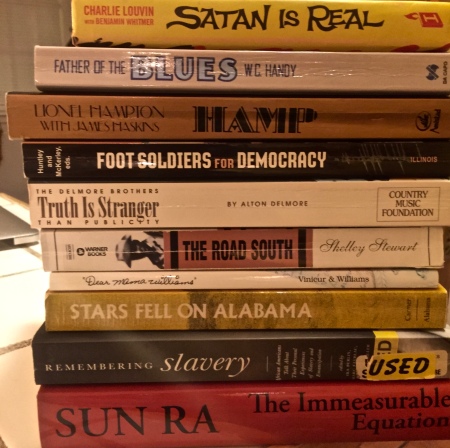
A couple of nights ago on a whim I started pulling books off their shelves and wondering: what would be the contents, hypothetically, of an Alabama Music Reader? This stack was a short start—but since going through these titles for their choicest passages I’ve been thinking of many more texts to include, and it seems more and more like a good idea.

img_3679

Recently on this blog I wrote about my lifelong penchant for making tables of contents. And so yesterday the habit kicked in and I began compiling a long table of contents for this (still hypothetical) reader. It’s a good list and growing, reflecting a broad mix of Alabama spirituals, fiddling, gospel, country, rock and roll, jazz, soul, the Sacred Harp, free improv, and more. Most of the readings are first-hand accounts (published and unpublished memoirs, oral histories, and interviews), but I’ve also got archival news clippings and there’s plenty of contemporary analysis and journalism to draw from, too. The book would cover, as best any one volume could, the full sweep of Alabama music, up to and including the wave of current successes—St. Paul, the Drive-By Truckers, Jason Isbell, the Alabama Shakes—that have brought our state so much good attention of late.

The more I think about this, the more I want to see it through. What do you say: anybody out there want to read this?

Mighty Soul Women

mighty-soul-2-text-2

Back in October, I put together for The Lost Child a radio show I called “Mighty Soul Women”—an hour of powerful soul anthems and R&B obscurities from the likes of Aretha Franklin, Etta James, Candi Staton, Merry Clayton, and more.

Next week I’ll be airing the sequel: Mighty Soul Women, Part 2. To get in the mood, I’d encourage you to listen to the original, which you can hear here, anytime.

A few highlights from Part 1, if you need convincing: there’s an incredible, funky cover of “Only Daddy That’ll Walk the Line,” the Waylon Jennings song—reworked here by a mostly forgotten singer, Pat Lundy, as the “Only Mama…” There are other fine, gritty, and wonderful covers: Big Maybelle’s “96 Tears,” Merry Clayton’s “Grandma’s Hands,” and Etta James’s slow-burning “Light My Fire.” We heard from Erma Franklin, a singer usually overshadowed by her legendary sister, Aretha—and overshadowed, again, by Janice Joplin’s more famous cover of “Piece of My Heart,” the song we heard this hour in Erma’s great original. We heard from Aretha, too, and several listeners wrote in to say they’d never heard the Aretha song I included (“Good to Me as I am to You”). I decided I should play more Aretha on The Lost Child; I think I’ll do an hourlong tribute later this year.

It’s hard for me to name just a few highlights from this episode.This show aired the week America was talking about “locker room talk”—so we heard Vicki Evans’s admonishment, “Don’t talk that kind of talk you’re talking to me,” and Laura Lee’s accusal: “You’re a dirty, dirty man—and you’ve got a dirty mind.” “Dirty Man” is a great song, Laura Lee a great singer. “I’m a good housekeeper,” she continues:

And I’m going to take my broom and sweep
all the dirt
out in the street.

We also heard from a couple of James Brown’s “funky divas,” those gutsy, powerhouse performers who sang with Brown’s classic traveling revue. And there was Ann Mason too, with a pointed answer song to Wilson Pickett: “You Can’t Love Me (In the Midnight Hour),” a tune released on Pickett’s own label, Atlantic, in the immediate wake of Pickett’s own hit. It’s a mostly forgettable (and forgotten) novelty, which adds nothing musically to the original; but the new lyrics, aimed squarely at the machismo of Pickett and his ilk, are refreshing, independent, and bold.

I haven’t even mentioned yet Betty Harris’s “Break in the Road,” as funky and tough as any two and a half minutes you could hope to hear—and have said nothing of Mavis Staples or Nina Simone. Just listen! Here’s the link again, if you missed it above.

Mighty Soul Women Part 2 airs this Saturday, January 21, at 9:00 a.m. (Central) on Birmingham Mountain Radio. You can hear it again Tuesday night, January 24, from 11 to midnight. And Saturday, January 28, you can hear it once more at Radio Free Nashville, 10-11 a.m. (still Central). Many singers from Part 1 will make an appearance, along with some new voices.

(The week after that, by the way, I’m doing the classic country version of all this. I made for my wife Glory a mixed CD a couple of years ago called “Badass Country Women”—fiery and empowering tunes from Loretta, Tammy, Wanda, Dolly, Hazel and Alice and more. On January 28 I’ll present the same mix, more or less, for the radio.)

Thanks for tuning in.

A message for desolate hearts

For today’s post I mostly want to share a poem I learned today, by Pablo Neruda, the Chilean poet. First, a quick backstory. (Skip the story and scroll straight to the poem if you like—I don’t mind!)

Last semester I had in my Creative Writing class an exchange student from Chile—for the sake of this blog, we’ll call him “Nico”—the sweetest, kindest kid you could hope to teach. It was a one-semester deal. His summer just started with the new year, and Friday he goes home; this week he unenrolled from our school. He stopped by today to say goodbye.

It’s one thing when a great kid graduates; you’ll still probably see that kid around, or at least you know it’s a possibility. But when that kid disappears to another hemisphere—that’s a real bummer. It was an emotional goodbye.

My other students are as brokenhearted about it as I am. Once last semester Nico was absent for just one day, and a student insisted we couldn’t go on without him. “He’s the backbone of this class!” she cried. I laughed but demurred. “You’re all the backbone of this class,” I said lamely, and I repeated it and hoped it sounded sincere: “This class has twenty backbones!” I did mean it, mostly. It really is a great group of students, and it’s an appealing metaphor, too—the class as a single freakish organism, made up of many backbones. But we all knew she was right. The day just wasn’t the same.

As it turned out, Nico and I got each other parting gifts. I gave him a copy of Ziggy Stardust; he was really into Bowie’s Blackstar album this year but hadn’t yet heard the stuff that made Bowie famous.

He gave me a Pablo Neruda book, one he had his mom send up from Chile. We’d read some Neruda in class last semester and watched the Italian movie about him, Il Postino. I’d shared with the class, among other things, Neruda’s poem, “Tonight I can write the saddest lines…,” and it made the whole room wonderfully miserable—a triumph for poetry. (I challenged the class to find a better break-up poem or break-up song than that one, anywhere. So far no one has.) We read Neruda’s “Ode to the Tomato” and wrote our own giddy odes to ordinary things. Whenever we’d read Neruda poems in class I’d asked Nico, since he was game, to read the originals out loud in Spanish, and the whole class would sit in attention; then someone would read a translation. I teach Neruda in Creative Writing most years. This year we did more than usual.

The book Nico gave me today was a Chilean edition of a book I’ve never heard of, 20 Poemas al Arbol y un Cactus de la Costa (20 Poems to Trees and a Cactus of the Coast). The poems are printed in Spanish and English, with beautiful illustrations opening each poem, every poem a different tree.

“Those who do not know the Chilean woods,” Neruda writes in a sort of preface, “do not know the planet. From those lands, from that soil and that mud, from that stillness, I have come out to walk, to sing throughout the world.”

*

After Nico left today I skipped to the last poem in the book, the “Ode to the Cactus of the Coast.” This is why I’m writing this post, to share a chunk of that poem.

It’s a good poem for any January—and, I think, for this January especially. The year opens not just with a sense of uncertainty but for a lot of us with anxiety and despair and, perhaps, a dangerous sense of depletion. At any rate, I know it was helpful for me to read these lines today. Maybe you’ll find help in them too, for reasons of your own. I plan to reread these words often, whenever I can use them.

The translation is by Mónica Cumar. The poem is a few pages longer than this, but this is how it ends, and how the book ends:

… Thus is the story,
and this
is the moral
of my poem:
wherever
you are, wherever you live,
in the last
solitude in this world,
in the scourge
of the earth’s fury,
in the corner
of humiliations,
brother,
sister,
wait, work
hard
with your little being and your roots.

One day
for you,
for all of us
from
your heart a red ray will burst forth,
you’ll also bloom one morning; the Spring
has not forgotten you, brother,
sister,
no,
it has not forgotten you:
I say it to you
I assure you of that,
because the terrible cactus,
the bristly
son of the sands,
conversing
with me
entrusted me with this message
for your desolate heart.

And now
I tell you
and I tell myself:
brother, sister,
wait,
I am certain:
Spring shall not forget us.

neruda-cover

Table(s) of Contents

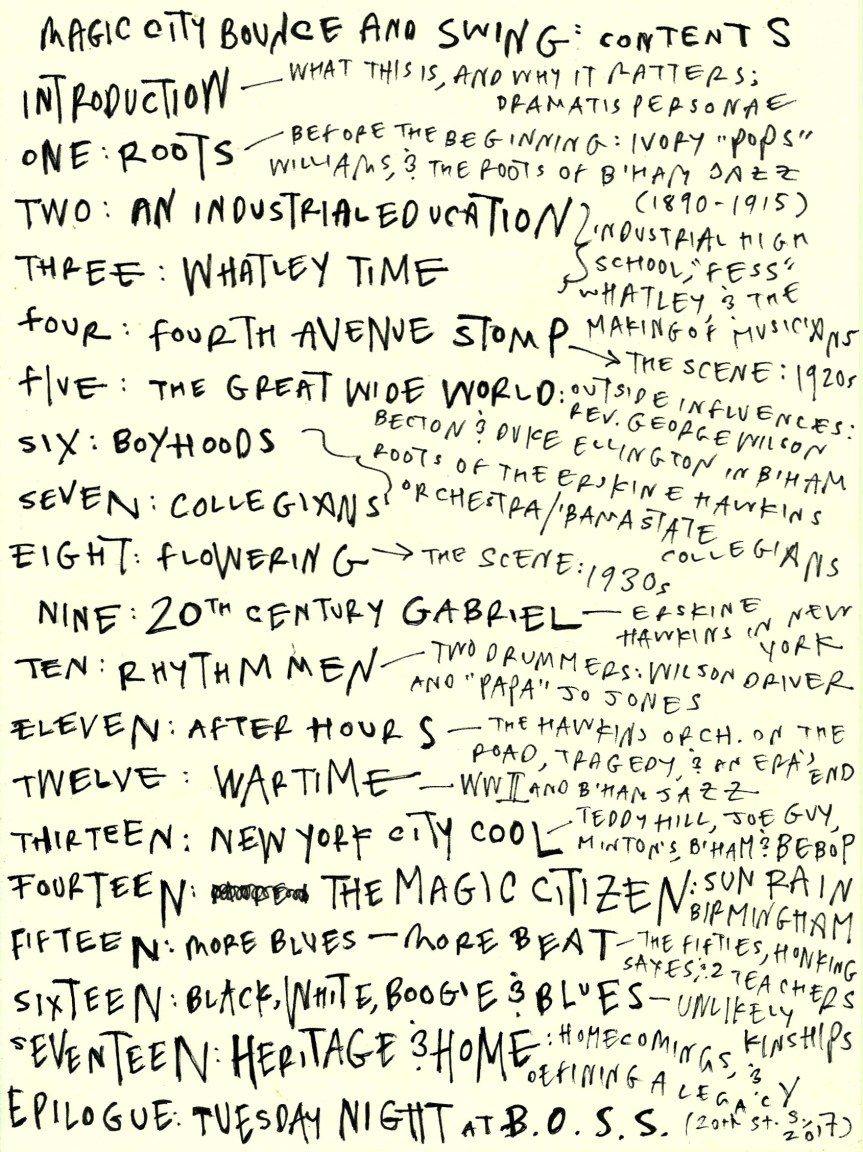
I said when I started this blog that one big purpose of the site was to complement my book in progress, my history of Birmingham jazz. I promised to share updates and outtakes, excerpts and footnotes, and to shed some light on the daily(ish) struggle of getting this thing onto paper, and (eventually) out to the world.

I haven’t posted a word about the book since then, so I thought I’d finally get to it today—and a table of contents seemed like a good, simple place to start. Sooner or later I’ll tell you more about why I’m writing this book, why I think the story’s so important, and what the overall gist of it is. In short, for now, it’s the story of how the unlikely city of Birmingham, Alabama helped shape the world of jazz—and of how jazz helped shape the city of Birmingham.

It’s a story that, for the most part, just hasn’t been told—at least not widely. People here in Birmingham don’t know it; neither do jazz lovers elsewhere. The book covers more or less a full century, revealing how the music programs of the city’s segregated black schools became a training ground for legions of jazz sidemen, arrangers, and a few notable bandleaders. I explore how a unique tradition of jazz musicianship helped generations of local players craft identities and experiences that transcended the limitations of the Jim Crow South—and examine how Birmingham players contributed actively, if largely from the sidelines, to the national culture of jazz. At the heart of the book is the swing era of the 1920s, ’30s, and ’40s, but we see also how Birmingham helped beget bebop—and how one Magic Citizen, the iconoclastic, otherworldly Sun Ra, pushed jazz to its furthest limits, even as he drew from his own Birmingham roots.

My working table of contents follows. The chapter titles may be a little cryptic on their own; my notes in the margins add a little bit of detail, but a table of contents is inherently a sort of tease. All but two of these chapters exist in some form now, though some are  further along than others. The book title you see here—Magic City Bounce and Swing—is one I intend to discard once I finally find something better. I’ve been brainstorming for a few years now and for the life of me can’t come up with a title I like. I’ve searched song lyrics and quotes for the right phrase, and I keep coming up with nothing. I invite your title suggestions in the comments.

table-of-contents

*

While we’re on the subject, an aside:

I spend a lot of time making lists of things, and the lists I’ve always enjoyed making most seem to be tables of contents. When I was a kid I was always making little books and filling them with stories, and always kicking them off on page one with a handy table of contents. I recently came across a little blank book my mom brought me home from the drugstore once, which I filled with two tiny novels: “Who’s Who?” and “The Christmas Mess.” It’s signed and dated 1988, so I guess I was eleven. It’s a pretty ambitious work, and it starts, of course, with a table of contents. For “Who’s Who” the TOC reads:

  1. Wadsworth – 1
  2. Spies – 9
  3. The Switch – 17
  4. Problems – 23
  5. Vampire Bob – 41
  6. Trouble – 47
  7. The Plan – 53
  8. Goodbye, Spies – 59
  9. Pop’s Diary – 63

Who wouldn’t want to read on, after that promise of things to come?

By seventh grade I was filling up notebooks and floppy discs with more tables of contents for more books I wanted to write or was secretly writing. In seventh and eighth grade I discovered real, written comedy: somehow before the internet ever happened, I’d managed to get my hands on copies of Monty Python’s two original Flying Circus books, published in the ‘70s, and Steve Martin’s absurdist collection Cruel Shoes, as well as The Complete Prose of Woody Allen, a compendium of Without Feathers and Getting Even and Side Effects. (I remember the Woody Allen book was on the sale table at Walden Books at the Montgomery Mall for $7.99 in a massive hardback, and I got a beat-up little blue and tan copy of Cruel Shoes at Montgomery’s one used-book store (that’s where I got Woody Guthrie’s Bound for Glory, too—see a previous post about that). I don’t know where I got the Monty Python books, maybe from a Signals catalogue or something similarly nerdy.)

Needless to say, my tables of contents reflected what I was writing, which reflected what I was reading: so in those days it was short, absurdist sketches and and silly comic essays. Every time I produced a few new pieces, I’d rearrange it all with a new table of contents.

In high school I discovered seriousness and poetry and I wrote many more tables of contents, outlining both my current writings and my future, unwritten—but carefully outlined—ambitions.

There were other tables, to be sure, in the years that followed. But jumping ahead to the table at hand:

Frank “Doc” Adams and I published our book Doc in 2012, and some months before it was done I wrote out my first table of contents for the book I’m writing now, the book outlined above. I’ve tweaked and rewritten this table of contents a million times. The contents and sequence have changed very little since I first charted it out: as the project has grown some chapters have split into half, or into three, but the overall flow sticks close to my initial conception. Sometimes I have to remind myself that rewriting the table of contents in my notebook, with minor adjustments, does not constitute writing, does not make a day’s work. Sadly, frankly, it’s on some days all I can do. Its’ tempting to let list-making stand in for true creative productivity; I remind myself often to resist the urge.

I might add this uncomfortable confession: that writing this book for so long I finally appreciate—I mean really appreciate—The Shining, a movie I’ve always loved but never before thought relatable. It’s not a happy revelation. I image Glory, horror-stricken, flipping through pages and pages of what I’ve written so far and discovering it’s all the same thing, over and over again. The same table of contents, the same chapters, the same sentences, revealing in their endless repetition my descent into madness. All work and no play… My own stomach sinks when I pick up my latest print-out: haven’t I typed out and held these words in my hands a thousand times already? I flip through my notebooks and find uncountable iterations of the same basic sequence and titles: IntroductionRootsAn Industrial Education 

I do make progress, though, little by little. And I stand proudly by my table—as the contents themselves slowly catch up to its promise.

(In the meantime, please: somebody send me a title.)


A Right Gude Willie Waught, & Musical Obits

On the radio for this New Year’s Eve morning I played a series of new year’s blues and jive and “Auld Land Syne,” and took a look back at some of the musicians we lost in the last year.  I’ve uploaded the show to the internet, so you can hear it here.

“This is a new year, people, the year 1936,” sings Mary Brown in “Happy New Year Blues”: “I tell all you people, I must get my business fixed.” During an instrumental break she instructs the musicians: “Play it for me ‘til I get young again!”

On January 1 of 1943 Woody Guthrie filled two pages of a notebook with 33 “New Year’s Rulin’s,” surrounded in the margins by his characteristic doodles. “STAY GLAD” is # 18 in his instructions for the new year. “DANCE BETTER” is 26. 33 is “WAKE UP AND FIGHT.”

*

I used to put together for The Lost Child an annual show, usually two back-to-back shows, I called “Where Dead Voices Gather” (the title came from the Nick Tosches book). It was a year-end celebration of all the musicians who’d died in the last twelve months. I’d feature the same sorts of people you might usually hear on my show—bluegrass players, rockabilly guitarists, small town fiddlers, New Orleans parade musicians, radio personalities, soul singers, and more, especially those players whose deaths might have been overlooked in the media at large—and I’d end with a roll call of all the last year’s musical dead, from any genre, calling out as many as I could name. I’d solicit names from friends to include members of music communities around the country: names of record store and venue owners, church organists, music writers, folklorists, and others. The lengthy roll call was inspired by Birmingham’s beautiful Day of the Dead Festival, with a nod too to the Anglican Prayers of the People.

“Where Dead Voices Gather” was my favorite Lost Child tradition, but it was a lot of work. In 2015 the list of the dead was just so big, and my November and December were so hectic and stressed that I just scrapped the whole thing. I figured I’d scrap it this year, too, daunted again by the task. But as I put together this week’s playlist of new year’s tunes I thought it’d be nice to include some Ralph Stanley and some Merle (“If We Make It Through December” seemed fitting). And then I built around those two a long set of other musicians we lost in 2016—not so much the songwriters, singers and players who’ve been so widely eulogized this year already, but some of the contributors whose deaths drew fewer tributes: people like Joe Ligon, the incredible lead singer for the Mighty Clouds of Joy. He died earlier this month at the age of 80. (His memorial service is on Youtube and, not surprisingly, it’s full of powerful gospel.) And then there was Billy Faier, banjo playing iconoclast, traveling companion of Woody Guthrie and Ramblin’ Jack Elliot, contemporary of Kerouac and the beats. Today’s show included his wonderful banjo reworking of “You Won’t See Me,” the Beatles song.

Next year I’ll bring back the full obituaries show. In a single set like today’s, there’s just so much omitted. I left out, for example, Tommy “Weepin’ and Cryin’” Brown, an old Atlanta R&B stalwart who made his name with the vocals on this song:

Check out his “Southern Women,” too:

Rest in peace—and thanks—to Tommy Brown, and to all the others.

And to all the musicians who were born in 2016, whose music is yet to come: Welcome! We’re glad you’re here.

*

One of my two favorite songs in the world is “Auld Lang Syne.” (My other favorite is the gospel song, “Glory, Glory.” One day I’ll write about both of these songs, maybe here or someplace else.) If you’re reading this post on New Year’s Eve, I hope you’ll sing the song tonight at midnight.

But here’s a link, too, to an online special I posted two years ago: 20 minutes’ worth of “Auld Lang Syne,” multiple iterations of it back to back to back. There’s a little overlap in this mix with this morning’s show, but there are some fine recordings here that aren’t there—like Aretha Franklin’s duet with Billy Preston from a 1987 TV special. There’s a nice instrumental version by James Allen Shelton, Ralph Stanley’s guitarist. And there’s one version that’s technically not “Auld Lang Syne” at all, it just shares the tune. “Plenary” is an old Sacred Harp song with lyrics by Isaac Watts—really dark ones, full of “certain gloom” and “walking … to the tomb.”

The lyrics to “Auld Lang Syne” itself, of course, are attributed to the Scottish poet Robbie Burns. Here’s my favorite verse, the last verse, in the original Scottish dialect. When you sing this verse you’re supposed to join hands with your fellow singers in a circle, reaching to your left with your right hand and your right with your left hand, tying your friendship in a knot:

       And there’s a hand, my trusty fiere!
      and gie’s a hand o’ thine!
      And we’ll tak’ a right gude-willie waught,
      for auld lang syne.

Your “fiere” is your friend; a “gude-willie waught”—those words are a joy to say, let alone sing—is a goodwill draft.

Yum.

Happy New Year’s, and cheers. Stay glad. Wake up and fight. See you in twenty seventeen.

*

P.S. Here’s Woody Guthrie’s complete rulin’s.

woody-guthrie-resolutions