Create Your Own Creative Writing Exam

For the last several years, the first semester exam for my high school creative writing class has come in two parts, spread out over a few class periods.

For Part One, students receive a small slip of paper that says “CREATE YOUR OWN CREATIVE WRITING EXAM,” and just a couple of sentences’ instruction. They have one 50-minute class period to create an exam for the course, and the only requirement is that they use the entire period. They may take the full 50 minutes to make the exam, or if they finish it before the period is over, they can actually take the exam themselves. One or two students usually panic, afraid that they won’t do it “right”; I more or less refuse to give any other direction, but if a student is sincerely worried I’ll just tell them, “Create an exam you would like to take” or “Just be true to the spirit of the course, and I promise you’ll be fine” — and after a little hand-wringing they start writing.

Somehow I usually manage to convince at least most of the students that Part Two of the exam will be completely unrelated to Part One, that Part One is a stand-alone exercise, a warm-up for something more exam-ish. But of course it is all a set-up: before they come back for Part Two I compile questions and prompts from all twenty-something exams into a single, epic document. They have a little more than two hours, over two days, to accomplish as much as they can. They can skip any questions and go in whatever order they want. Again, the only requirement is that they use the entire allotted time: they shouldn’t try to do it all, just to do as much as they can.

Both parts of the exam are always great fun for me to read. I’m always impressed by how funny and poignant, how creative and absurdist and profound these students can be, even in the middle of exam week, and I’m always reminded how glad I am to know all of them.

In case you would like to take this year’s exam for yourself, I am posting it in the link below. Set a timer for 60 or 90 minutes or whatever feels right and see what you can do. I did not create any of these questions; each one was created by a sophomore, junior, or senior in high school.

Good luck.

Create Your Own Creative Writing Exam 2017

P.S. A couple of students’ questions reference the wonderful artist and writer Lynda Barry and this 14-minute video, which we’d recently watched in class — and which I recommend also to you.

New Year’s Hankathon

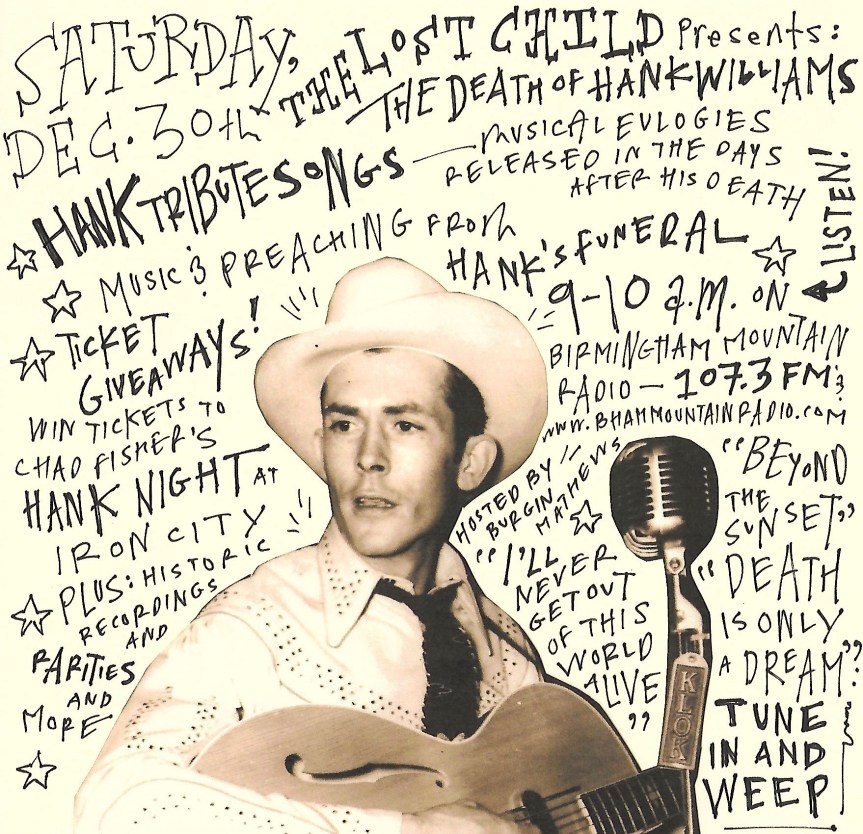
Tomorrow, New Year’s Day 2018, marks the 65th anniversary of the death of Hank Williams; and to commemorate the date I’ve got four hours of Hank tributes from The Lost Child — the perfect soundtrack, I think, to your black-eyed peas and new year’s greens.

First, here’s the extended edition of this weekend’s show, the Hank Death Show. This is something I’ve wanted to do for a while, and this 65th anniversary seemed like good timing: we listened back to Hank’s historic funeral and heard some of the (many!) Hank tribute songs released in the wake of his death, along with some original Hank records and radio broadcasts. The extended online version includes more of the funeral than I could squeeze into my usual broadcast hour, plus a further look into all those tribute records.

That show was a sort of epilogue to this show, Hank at 90, the three-hour tribute I aired on the 90th anniversary of Hank’s birth, back in 2013. “Hank at 90” pulled together into one place many years of Hank collecting and obsessing on my part, and it’s still one of the most popular episodes of The Lost Child. There are Hank classics and obscurities, reflections from Hank’s old bandmates, a look into the roots of Hank Williams (including the evolution of the “Lovesick Blues” and “Jambalaya”), and, best of all, a world of Hank covers — including gospel, conjunto, soul, zydeco, doo-wop, ’60s psychedelic Thai pop  covers, and more. Here’s the playlist, if you’d like to follow along:

  1. Hank Williams: Honky Tonk Blues (Live, Grand Ole Opry, 1952)
  2. Dean Martin: Wedding Bells
  3. Johnny “Guitar” Watson: Cold, Cold Heart
  4. Conjunto Atardecer: Jambalaya
  5. Hank Williams: Settin’ the Woods on Fire
  6. Johnny Cash: I Heard that Lonesome Whistle
  7. The Maddox Brothers and Rose: Honky Tonkin
  8. Minnie Pearl and Hank Williams: Live on the Grand Ole Opry, 1950
  9. Hank Williams: Next Sunday Darlin’ is My Birthday (Live, Mother’s Best radio show, WSM, 1951)
  10. Piano Red: Hey Good Lookin’
  11. Billy Lee Riley: Kaw-Liga
  12. Papa Cairo: Grand Texas
  13. Chuck Guillory: Grand Texas
  14. Hank Williams: Jambalaya (Live, Grand Ole Opry, 1952)
  15. Louis Keppard: Bucket’s Got a Hole in It
  16. Washboard Sam: Bucket’s Got a Hole in It
  17. Hank Williams: My Bucket’s Got a Hole in It (demo)
  18. Esther Phillips: I Can’t Help It (If I’m Still in Love with You)
  19. Hank Williams radio interview with Mack Sanders, WFBI, Wichita, KS, 1951
  20. Hank Williams as Luke the Drifter: Ramblin’ Man
  21. Louis Armstrong: Your Cheatin’ Heart
  22. Isidro Lopez: Kaw-Liga
  23. The Five Crowns: You Win Again
  24. Kenneth “Jethro” Burns: You Win Again
  25. Bill Monroe: I’m Blue, I’m Lonesome
  26. Braxton Shooford (Braxton Schuffert): Rockin’ Chair Daddy
  27. Big Bill Lister: Countrified
  28. Big Bill Lister: There’s a Tear in My Beer
  29. Big Bill Lister: Story Behind “There’s a Tear in My Beer”
  30. Hank Williams, Sr. & Hank Williams, Jr.: There’s a Tear in My Beer
  31. Bob Log III: Settin’ the Woods on Fire
  32. Hank Williams as Luke the Drifter: A Picture from Life’s Other Side
  33. Elvis Presley: Men with Broken Hearts (Las Vegas, 1970)
  34. Dinah Washington: Cold, Cold Heart
  35. Hank Williams: You’re Gonna Change (Or I’m Gonna Leave) (Live, Grand Ole Opry, 1949)
  36. Audrey Williams: Tornado of Love
  37. Lloyd Clarke: Half as Much
  38. Lum York: Memories of Hank Williams (My Life and Times with Hank Williams, Sr.)
  39. Hank Williams: Mother’s Best radio show excerpt, featuring “I Saw the Light” (1951)
  40. Emmett Miller: The Lovesick Blues
  41. Rex Griffin: Lovesick Blues
  42. Hank Williams: Lovesick Blues
  43. Porter Wagoner: Porter and Marty (Men With Broken Hearts / I Heard That Lonesome Whistle)
  44. Link Wray: I’m So Lonesome I Could Cry
  45. Silver Sand: Kaw-Liga
  46. Hank Williams: How To Write Folk and Western Music To Sell
  47. Zelenáči (Greenhorns) & Miroslav Hoffman: Posledni hrana (Long Gone Lonesome Blues)
  48. Hank Williams: Weary Blues from Waitin’ (demo)
  49. The Golden Crusaders: Hey Good Lookin’
  50. Hank Williams: On Top Of Old Smoky (Live, Mother’s Best radio show, 1951)
  51. Preston Fulp: Wedding Bells
  52. James Brown: Your Cheatin’ Heart
  53. Hank Williams: radio interview with Bob McKinnon, Alexander City, AL, 1950
  54. Jack Cardwell: The Death of Hank Williams
  55. Dr. Henry L. Lyon: Hank Williams eulogy (excerpt), Highland Avenue Baptist Church, Montgomery, AL, 1953
  56. Johnnie and Jack: Hank Williams Will Live Forever
  57. The Five Blind Boys of Alabama: I Saw the Light
  58. Hank Williams: I’m Gonna Sing, Sing, Sing

Hank Death Show copy

In Birmingham the night before New Year’s each year is Hank Night, bandleader Chad Fisher’s annual tribute to the music of Hank Williams (Hank spent the night of January 30, 1952 in Birmingham, on his way to the gig he never made). Each year it’s an incredible night. For the last three years I’ve had the honor of introducing the band onstage and saying a few words about Hank. This is more or less what I said last night:

Happy Hank Night.

65 YEARS AGO TONIGHT(!!)
Hiram Hank Williams
pulled into the city of Birmingham
in the middle of a snowstorm

in his eggshell blue Cadillac convertible
on his way to a New Year’s gig in Canton, Ohio

He checked into the Redmont Hotel downtown and got a room for the night.
It was his last night in any bed
And the last night whose morning he’d live to see.

In the morning Hank got back on the road
but somewhere in the dark hours
between New Year’s Eve and New Year’s Day
he breathed out his last breath; and
somewhere around Oak, Hill, West Virginia
his driver pulled over to discover him dead.

In life Hank wrote a litany of hits:
     “Hey Good Lookin'”
     “Jambalya”
     “Your Cheatin’ Heart”
     “Cold Cold Heart”
     “I Saw the Light”
     “Kaw-liga”
     And too many others to name

When he died DJs all over the country saturated the airwaves with his songs
and put also onto their turntables a world of Hank tribute records
so many musical eulogies they constituted a kind of miniature genre unto themselves

Songs like:
     “The Life of Hank Williams”
     “The Death of Hank Williams”
     “In Memory of Hank Williams”
     “Ode to Hank Williams” 

     “A Tribute to Hank Williams, My Buddy”
     “Hank Williams, That Alabama Boy”
     “Singing Teacher in Heaven”
     “Guest Star in Heaven”
     “Heart’s Hall of Fame”
     “That Heaven Bound Train”
     “When Hank Williams Met Jimmie Rodgers”
     “Hank Williams Will Live Forever”
     “Hank Williams Isn’t Dead”
     “Hank, It Will Never Be the Same Without You”
     And more

One of Hank’s recent hits, “I’ll Never Get Out of this World Alive,” was still on the charts
And that song, which a few months ago had just been a jokey, catchy novelty tune

Became suddenly endowed with a tragic, near-mystic significance

Hank’s record label rushed to release a posthumous anthology of all the records Hank
     had made as Luke the Drifter
     his moralizing, sermonizing alter-ego,
a collection meant to assure Hank’s fans that for all the hell-raising for which Hank was
known
Hank had believed above all in mama and God and sweet sacred things and home.

The DJs read out over the airwaves the home address of Hank’s mama, Lily Stone in
Montgomery
urging their listeners to send their condolences
So a flood of cards and letters

poured by the hundreds into her mailbox
and filled up as best as they could the empty spaces in her home

There were letters from housewives
and farmers
teenagers
and aspiring songwriters
from black listeners and white listeners

and GIs stationed in Korea and in Germany.

A letter from Eua Claire, Wisconsin, was addressed to “The Mother of Country Music”
and said, quote:
     “I’d love to come to your home and see Hank’s room
and feel his nearness everywhere.
     Do you think Hank would care?”

I grew up in Montgomery some years after all this
and Hank’s nearness could still be felt if you knew how to look for and feel it.
When the Hank Williams Museum got ready to open there in 1999
a headline appeared on the front page of the Montgomery Advertiser
     my hometown paper
announcing the appearance of what seemed to be Hank’s ghost
in a piece of plywood
at the museum’s construction site.
A contract painter, the paper said, had discovered in the wood grain
–o
n December 31, of all possible dates, just days before the museum’s opening–
the image of a cowboy hat
and then of a guitar
and next to that the letters HW;
a few days later, a cowboy boot had “appeared” in the grain
and the museum’s owner told the paper:
“We don’t know what will appear next.”
Quote: “It’s strange”

But strange things happen in country music
and God knows strange things happen in Alabama

David Allen Coe in the ’80s and Allen Jackson in the ’90s both wrote new sorts of tribute
     songs, describing run-ins with Hank’s ghost in and around Montgomery
and Waylon Jennings’s tour bus always kept one empty bunk open for Hank’s ghost,
which Waylon said came around often for the ride and a talk.

Hank just can’t seem to leave us alone.
And we can’t leave him alone either.

Hank Williams seems to fill for millions of us some kind of essential need
and 65 years after he last pulled through this town

we still have limitless room for his Ghost.

For nine years Chad Fisher has brought to Birmingham one of the greatest nights this
     city knows,
assembled on this stage one of the most joyous and inspiring lineups of talent we might
hope to hear
and it’s a joy to be with you all here tonight
for Hank Night Nine.

Ladies and gentlemen, friends and neighbors,
     Chad Fisher
     and the Hank Night Band.

One last thing or two for now, speaking of musical New Year’s traditions: here’s 20 minutes’ worth of “Auld Lang Syne” to help ring in the new — and a blog post from this time last year, with still more(!!) New Year’s listening from The Lost Child.

Happy new year, and long live Hank Williams. See you in 2018.

hank!

Audio Archive: Frank “Doc” Adams remembers…

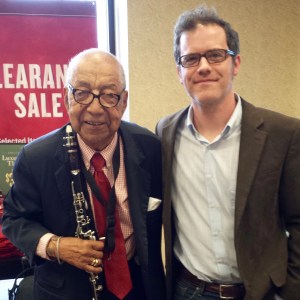
This weekend marks the five-year anniversary of the publication of my book with the great, much-beloved Alabama jazz hero, Dr. Frank Adams: a master performer, educator, family man, community icon, storyteller, and history-keeper known to many around here as “Doc.” Our book — Doc: The Story of a Birmingham Jazz Man — tells Frank Adams’s story in his own words, drawing from more than two years of weekly interviews.

To celebrate the anniversary of the book’s publication, I’ve uploaded the first few minutes of the first interview I conducted with Doc, from July of 2009 (in the recording below, I attribute this interview to 2002, not catching my verbal typo). At the time, I thought I’d write an article about Doc and about the history of Birmingham jazz community. Most of all I wanted to preserve some of this man’s remarkable story and storytelling for posterity; beyond my vague ideas for an article I didn’t have much of a plan. But this interview turned into many more interviews, which turned in turn into our book — and eight(!!) years later, I’m still very hard at work on the book that’s grown out of that one, a history of jazz in Birmingham, and of Birmingham in jazz.

Doc died two years after the publication of this book — three years ago this month. It’s a joy to hear his voice again in this recording. I remember vividly the day of this interview, sitting across from Doc in his office, engrossed in his stories and his spirit. I had no idea that we’d record ninety-something more of these interviews, no idea that this recording would become the opening pages of our book. I certainly did not anticipate the friendship and collaboration that would grow out of this first session. For that friendship, above all, I’ll be eternally grateful.

IMG_20140222_151410

When the book was finished, Doc constantly instructed me: “Keep the book in front of people.” He believed, and I believe, that it told an important story — a story about more than jazz, and more than Birmingham — and a story that ought to be widely shared. He didn’t want it collecting dust on book shelves but wanted it to pass through as many hands as it could. So I’ll remind you on its anniversary that’s it’s still available from Amazon — and right now available at the best price I’ve seen on it yet. Maybe your library has it, or maybe you can get your library to get it. If you’re in Birmingham, we’ve got it for sale at our new store, The Jaybird. However you get your hands around it, I hope you’ll spend some time with this book and with Doc.

Meanwhile, here’s how this whole thing started: Dr. Frank Adams sitting in his office, age 81, talking about his father and his brother and his mother, and about his first musical performance — a brothers’ duet of “The Old Rugged Cross,” performed for the congregation of Birmingham’s Metropolitan A. M. E. Zion Church.

“That,” he said, “sort of hooked me on music.”

Happy anniversary, Doc.

Remembering Ralph (1928-2017)

Tomorrow on The Lost Child: You might not know Ralph Lewis, but you should. The seventh son of a seventh son, he was born into the Great Depression in the mountains of Madison County, North Carolina. By five or six he was getting his hands around a mandolin and soon was sitting in with brothers Ervin and Blanco, The Lewis Brothers, a popular regional act. When Blanco was killed in WWII, Ralph joined Ervin as half of the brother duet, developing a following around Niagara Falls, New York. By the late forties Ralph had landed in Detroit, where an audience, made largely of displaced Southerners, packed out local venues to hear his mixing of mountain music tradition with a creative, propulsive, high-energy bent: “I was playing rock ‘n’ roll and didn’t know it,” he later said, suggesting an affinity with modern sounds that would last his whole life. He moved back to North Carolina and played in a number of bands before joining Bill Monroe’s Bluegrass Boys in 1974, at a peak in Monroe’s career. After touring the U.S., Japan, and Europe with Bill Monroe, Ralph returned to Madison County, choosing to develop a band with his young sons, Marty and Don.

I first encountered Ralph, Marty, and Don when I moved to Asheville, NC, in the year 2000. Their band, The Sons of Ralph (Featuring Ralph) was an enormous local favorite, especially at Jack of the Wood, the downtown stage they made their headquarters. As he always had, Ralph mingled his family’s mountain music traditions with a wide-open, innovative embrace of influences, and with Marty and Don at his side Ralph was more than ever pushing the boundaries of bluegrass–really forgoing boundaries altogether–and mixing in an eclectic, electric range of sounds from rock and roll to reggae to Cajun music and beyond.

Ralph remained a fixture of the area’s musical culture and scene until his death last Saturday at the age of 89. I am grateful for the opportunities I got to see him and Marty and Don and their band, live on stage–grateful for the opportunities to participate in a community and family that extended beyond the stage to every person in the room.

I’m going to do my best tomorrow to play/pay tribute to Ralph on the radio. I’ll play a bunch of Sons of Ralph songs, and a recording or two of Ralph playing with Bill Monroe in Japan. I’ll play a few excerpts from an interview I recorded with Ralph in 2002. I will leave some things out, I’m sure, but it will be a heartfelt tribute anyway to a musician and a man I’ll always admire. You should tune in.

ralph

The Lost Child airs Saturday morning from 9 to 10, Central, on Birmingham Mountain Radio: 107.3 in Birmingham, Alabama; 97.5 in Tuscaloosa; and streaming online every & anywhere at www.bhammountainradio.com. It will air again on Tuesday evening, 8/15, from 11 to midnight (also Central), at the same places. And it’ll air a final time at Radio Free Nashville a week from tomorrow: on Saturday, 8/19, from 10-11 (Central again). You can hear it there around Nashville, Tennessee, at 103.7 & 107.1 FM, or you can stream it anywhere at www.radiofreenashville.org.

Thanks, Ralph. Rest in peace–or, better than rest: keep having a raucous good time up there. You’ll be missed down here.

Blues for Sunday Morning

I woke up this morning and made a sweet lazy Sunday playlist of (mostly) downhome blues. You can listen to it here, or just scroll to the bottom of this post.

Included is an epic story song, “Jaybird,” by Scott Dunbar, recorded in the summer of 1968 on the bank of Lake Mary, Mississippi, by folklorist Bill Ferris. Ferris describes “Jaybird” as “a cante-fable — a sung story — about a young man who courts his sweetheart. He brings corn whiskey to her parents to make them fall asleep, and then he courts their daughter through the night.”

Scott Dunbar says this of the song: “I made that one up. That’s the jaybird in the air. I made that one about how you cut out the momma and the poppa so you can talk to the daughter.”

This playlist draws, among other things, from some really wonderful collections of field recordings. I suggest you check any and all of them out:

+ The George Mitchell Collection, Volumes 1 – 45 

+ Art of Field Recording: Traditional Music Documented By Art Rosenbaum

+ Drop On Down In Florida: Field Recordings of African American Traditional Music, 1977-1980

+ The Blues: Music from the Documentary Film by Sam Charters

+ Give My Poor Heart Ease: Voices from the Mississippi Blues, by William Ferris

+ In Celebration of a Legacy: The Traditional Arts of the Lower Chattahoochee Valley

+ Black Banjo Songsters of North Carolina and Virginia 

There’s also music here from Elizabeth Cotten, Pink Anderson, Algia Mae Hinton, Precious Byrant, Jesse Fuller, and others. Mississippi John Hurt sings this prayer, from his last recording sessions, in 1966:

Blues all on the ocean, blues all in the air
Can’t stay here no longer, I have no steamship fare
When my earthly trials are over, cast my body out in the sea
Save all the undertaker’s bills — let the mermaids flirt with me.

The lovely accompanying photo of John Hurt with Elizabeth Cotton was taken by Joe Alper at the Newport Folk Festival, 1964.

Hope you enjoy the mix. Happy Sunday, and peace.


Make America America

In about a week we start another school year — my thirteenth year teaching, and my first to teach eleventh graders.

I’m excited for the new class. There’s a unit on the Harlem Renaissance, so this week I started pulling down and rereading some favorite poems and stories, trying to decide which texts to share with my kids. I’ve been flipping especially through the giant Collected Poems of Langston Hughes, one of the first books of poetry I ever bought. It’s been a while since I’ve read “Let America Be America Again,” first published in 1936; I look forward to reading it with my students in the new age of #MAGA.

If you don’t know it, check it out, below. If you do, why not slow down to read it again?

Langston Hughes.jpg

Let America Be America Again

Let America be America again.
Let it be the dream it used to be.
Let it be the pioneer on the plain
Seeking a home where he himself is free.

(America never was America to me.)

Let America be the dream the dreamers dreamed—
Let it be that great strong land of love
Where never kings connive nor tyrants scheme
That any man be crushed by one above.

(It never was America to me.)

O, let my land be a land where Liberty
Is crowned with no false patriotic wreath,
But opportunity is real, and life is free,
Equality is in the air we breathe.

(There’s never been equality for me,
Nor freedom in this ‘homeland of the free.’)

Say, who are you that mumbles in the dark?
And who are you that draws your veil across the stars?

I am the poor white, fooled and pushed apart,
I am the Negro bearing slavery’s scars.
I am the red man driven from the land,
I am the immigrant clutching the hope I seek—
And finding only the same old stupid plan
Of dog eat dog, of mighty crush the weak.

I am the young man, full of strength and hope,
Tangled in that ancient endless chain
Of profit, power, gain, of grab the land!
Of grab the gold! Of grab the ways of satisfying need!
Of work the men! Of take the pay!
Of owning everything for one’s own greed!

I am the farmer, bondsman to the soil.
I am the worker sold to the machine.
I am the Negro, servant to you all.
I am the people, humble, hungry, mean—
Hungry yet today despite the dream.
Beaten yet today—O, Pioneers!
I am the man who never got ahead,
The poorest worker bartered through the years.

Yet I’m the one who dreamt our basic dream
In the Old World while still a serf of kings,
Who dreamt a dream so strong, so brave, so true,
That even yet its mighty daring sings
In every brick and stone, in every furrow turned
That’s made America the land it has become.
O, I’m the man who sailed those early seas
In search of what I meant to be my home—
For I’m the one who left dark Ireland’s shore,
And Poland’s plain, and England’s grassy lea,
And torn from Black Africa’s strand I came
To build a ‘homeland of the free’.

The free?

Who said the free? Not me?
Surely not me? The millions on relief today?
The millions shot down when we strike?
The millions who have nothing for our pay?
For all the dreams we’ve dreamed
And all the songs we’ve sung
And all the hopes we’ve held
And all the flags we’ve hung,
The millions who have nothing for our pay—
Except the dream that’s almost dead today.

O, let America be America again –
The land that never has been yet –
And yet must be – the land where every man is free.
The land that’s mine—the poor man’s, Indian’s, Negro’s, ME —
Who made America,
Whose sweat and blood, whose faith and pain,
Whose hand at the foundry, whose plow in the rain,
Must bring back our mighty dream again.

Sure, call me any ugly name you choose—
The steel of freedom does not stain.
From those who live like leeches on the people’s lives,
We must take back our land again,
America!

O, yes,
I say it plain,
America never was America to me,
And yet I swear this oath—
America will be!

Out of the rack and ruin of our gangster death,
The rape and rot of graft, and stealth, and lies,
We, the people, must redeem
The land, the mines, the plants, the rivers.
The mountains and the endless plain—
All, all the stretch of these great green states—
And make America again!

*   *   *

P.S. I kind of took a summer break from this blog; hopefully I can get back again soon into the habit of regular posting. Thanks for reading. Stay tuned.

In the meantime, here’s something good you can store away for a rainy day (or a sunny one) soon: Langston Hughes speaking at UCLA in February of 1967, just months before he died.

Peace.

This Is What You Shall Do

This one’s quoted often but rewards frequent revisits. So — from the original preface to Walt Whitman’s Leaves of Grass, published in 1855 …

Version 2

“This is what you shall do; Love the earth and sun and the animals, despise riches, give alms to every one that asks, stand up for the stupid and crazy, devote your income and labor to others, hate tyrants, argue not concerning God, have patience and indulgence toward the people, take off your hat to nothing known or unknown or to any man or number of men, go freely with powerful uneducated persons and with the young and with the mothers of families, read these leaves in the open air every season of every year of your life, re-examine all you have been told at school or church or in any book, dismiss whatever insults your own soul, and your very flesh shall be a great poem and have the richest fluency not only in its words but in the silent lines of its lips and face and between the lashes of your eyes and in every motion and joint of your body.”

IMG_0209

Things Found in Books

Alongside the tables and booths at Crestwood Coffee runs a row of old and donated books, with a “take a book, leave a book” policy. Yesterday I picked up this one, from 1939: Ted Malone Presents The American Album of Poetry. Ted Malone (I’ve since learned) hosted a popular CBS radio show, “Between the Bookends” for more than thirty years, and on it he championed the everyday poetry of everyday people. “This Album,” the intro to his book begins, “is made up of poems written by poets—but these are the poets who in daily life are housewives, business men, professional people, teachers and students, and their poems are composed wholly for the joy of self-expression.”

The coffee shop copy also bears a handwritten inscription, dated May 10, 1941: How about going poetic, it says—From Your Brother & Sister, Alonzo & Alma. And stuck between the pages of the book are a few typewritten pages of poetry, each signed L. C. Steiner, Jr. Whoever Steiner was, he seems to have been just the sort of poet Ted Malone would have loved: neatly typing his poems on the backs of business stationery (Alexander Motors, Mobile, Alabama), numbering them in pencil, and folding them up and sticking them inside the Album. My favorite of the batch, “Tribute to King Booze,” begins:

       A man does strange things when he gets himself drunk.
       His legs go to shaking and his mind’s full of junk.

Here’s the whole thing. You can barely make out the Alexander Motors letterhead through the paper.

Jesse James inside cover

*

I’m always on the lookout for inscriptions, marginalia, and things stuffed between the pages of old books; they let us glimpse the ghosts of readers past. We get through these artifacts only a cryptic fraction of a larger story and are left to wonder at the rest. What about L. C. Steiner? If he’s the brother to whom the book was inscribed, did the gift inspire him to “go poetic” as challenged—or was he a secret poet already?

Who else got to read his poems?

*

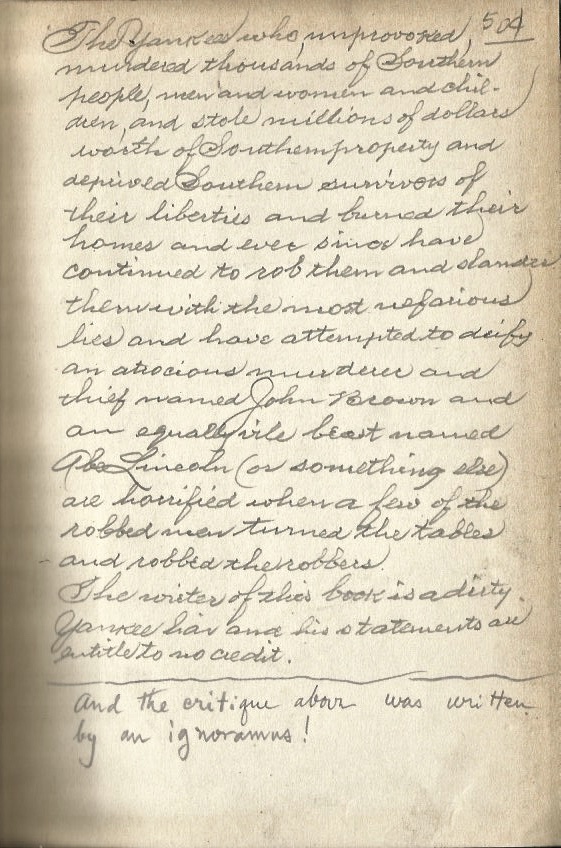
Several years ago in a Chapel Hill bookstore I bought an old biography of Jesse James for fifty cents. The Rise and Fall of Jesse James was published in 1926, its author Robertus Love; my copy belonged at one point to the Sondley Reference Library in Asheville, North Carolina. I haven’t read it and don’t expect to; I laid down my fifty cents for the sake of this lengthy tirade written on the book’s first blank page:

Version 2

Here’s what it says, in case you find that hard to read:

The Yankees who, unprovoked, murdered thousands of Southern people, men and women and children, and stole millions of dollars worth of Southern property and deprived Southern survivors of their liberties and burned their homes and ever since have continued to rob them and slander them with the most nefarious lies and have attempted to deify an atrocious murderer and thief named John Brown and an equally vile beast named Abe Lincoln (or something else) are horrified when a few of the robbed men turned the tables and robbed the robbers.

The writer of this book is a dirty Yankee liar and his statements are entitled to no credit.

If that were not enough, there’s a rejoinder underneath, from another, more modern hand: And the critique above, it announces, was written by an ignoramous!

This, I suppose, is what lately we’ve come to call “trolling”; it’s the Youtube comments before there was Youtube.

And there’s more, too: finally, a third voice weighs in at the top of the page, rendering a final judgment on the entire affair—book, notes, and all.

50¢, it says. A steal!

*

What’s the most interesting thing you’ve found inside an old book? I invite you to describe your favorite finds in the comments below. But first, here’s a poem by Billy Collins, another lover of poetry in the everyday .

It’s called “Marginalia.”

Sometimes the notes are ferocious,
skirmishes against the author
raging along the borders of every page
in tiny black script.
If I could just get my hands on you,
Kierkegaard, or Conor Cruise O’Brien,
they seem to say,
I would bolt the door and beat some logic into your head.

Other comments are more offhand, dismissive –
“Nonsense.” “Please!” “HA!!” –
that kind of thing.
I remember once looking up from my reading,
my thumb as a bookmark,
trying to imagine what the person must look like
who wrote “Don’t be a ninny”
alongside a paragraph in The Life of Emily Dickinson.

Students are more modest
needing to leave only their splayed footprints
along the shore of the page.
One scrawls “Metaphor” next to a stanza of Eliot’s.
Another notes the presence of “Irony”
fifty times outside the paragraphs of A Modest Proposal.

Or they are fans who cheer from the empty bleachers,
hands cupped around their mouths.
“Absolutely,” they shout
to Duns Scotus and James Baldwin.
“Yes.” “Bull’s-eye.” “My man!”
Check marks, asterisks, and exclamation points
rain down along the sidelines.

And if you have managed to graduate from college
without ever having written “Man vs. Nature”
in a margin, perhaps now
is the time to take one step forward.

We have all seized the white perimeter as our own
and reached for a pen if only to show
we did not just laze in an armchair turning pages;
we pressed a thought into the wayside,
planted an impression along the verge.

Even Irish monks in their cold scriptoria
jotted along the borders of the Gospels
brief asides about the pains of copying,
a bird singing near their window,
or the sunlight that illuminated their page–
anonymous men catching a ride into the future
on a vessel more lasting than themselves.

And you have not read Joshua Reynolds,
they say, until you have read him
enwreathed with Blake’s furious scribbling.

Yet the one I think of most often,
the one that dangles from me like a locket,
was written in the copy of Catcher in the Rye
I borrowed from the local library
one slow, hot summer.
I was just beginning high school then,
reading books on a davenport in my parents’ living room,
and I cannot tell you
how vastly my loneliness was deepened,
how poignant and amplified the world before me seemed,
when I found on one page

a few greasy looking smears
and next to them, written in soft pencil–
by a beautiful girl, I could tell,
whom I would never meet–
“Pardon the egg salad stains, but I’m in love.”


Today’s playlist (illustrated)

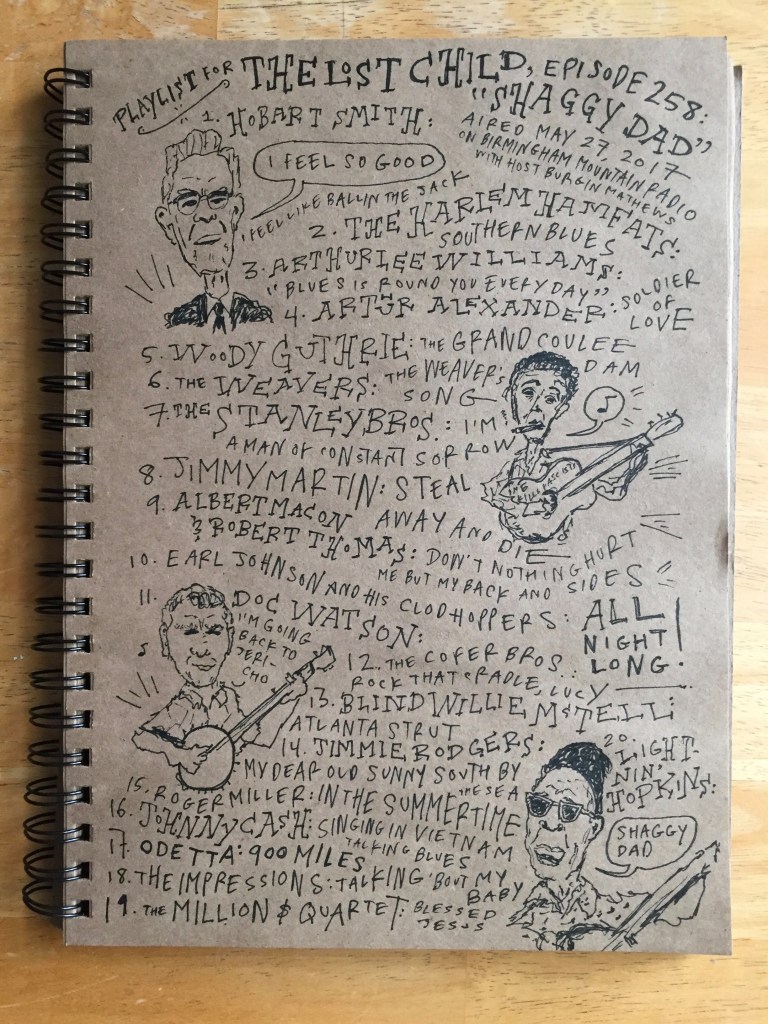
Here’s an illustrated playlist for this morning’s episode of The Lost Child:

Version 2

Hobart Smith (1887-1965), pictured top left above, opened today’s show with these unaccompanied lyrics, his take on an old Big Bill Broonzy tune, “I Feel So Good”:

I got a letter, come to me by mail
Says my baby’s coming home, and I hope that she don’t fail
‘Cause I feel so good
Yes, I feel so good
I feel so good, I feel like ballin’ the jack

I love my women
Crazy ’bout my garden gin
When I get high, my baby,
I feel like floating round in the wind
‘Cause I feel so good
Yes, I feel so good
I feel so good, I feel like ballin’ the jack

Happy Saturday, everyone.

Advice to seniors

I wrote these words originally for the class of 2015 but I think & hope, two years later, that the advice still stands. My school’s latest batch of seniors threw their hats in the air tonight. In their honor, I’ll share these thoughts again here. I hope it’s not too preachy, hokey, or obvious. But these are things I think young people should know.

Advice to Seniors
May, 2015

Know this: you are not supposed to have everything—possibly, you are not supposed to have anything—figured out. Knowing the questions is much more important than knowing the answers. There is more wisdom in asking than in answering. Embrace the unknown. Embrace confusion. Cultivate an enthusiasm for question marks. Be open to, and excited by, the unexpected.

Learn to improvise.

Frequent taco trucks.

Eat watermelon in the summer, as much of it as you can.

Develop a taste for Indian food, and, wherever you live, know which Indian restaurants you like the best and why.

Prepare meals for and with your friends.

Unless you are in love or in deep conversation with a friend and it’s already almost sunrise, there is never a good reason to stay up all night.  Work—schoolwork or otherwise—is not a good enough reason: one or two all-nighters, total, is the most you should experience in life, for the sake of school or work.

Practice forgiveness.  Forgive everyone, including yourself.  The strength of your character depends upon your ability to forgive.

Seek out the people that inspire you.  Surround yourself with them.

Listen to people you disagree with.  Work to understand what they really think, and why.  Assume they may be right.

Try to know everyone.

Make friends with people who do not look, talk, think, or act like you.  You need each other in your lives.

Smile at strangers.

When you see them on the street, look homeless people in the eye.

Do not be afraid to say hello.

Talk to old people.  Listen to old people.  Ask them questions.  Not just your grandparents, either.

Ask kids questions.  Listen to their answers.

Do not be afraid of your own singing voice.  Never tell anyone, “I can’t sing,” unless it is also true that you can’t talk.  You do not need to be professional and are not expected to be.  Sing in the car or with friends or in the shower or while you worship, or sing to an infant.  Always sing on New Year’s.  Know at least the first verse and chorus of “Auld Lang Syne” by heart.

Read good books.

Listen to good music.

(How do you know if music is good? If you like it! If it makes you smile, or move, or think, or laugh, or sing; if it makes you feel good, or feel whatever it is that you need to feel. If it in any way at any moment makes things around you or in you somehow better than they already are.)

Never interrupt a conversation for the sake of your cell phone.  If there is a live human being sitting or standing in front of or next to you, keep your phone in your pocket.  In fact: if you are standing in line alone, also keep your phone in your pocket.  Learn how to be alone, comfortably, with nothing but your thoughts.

If you are in school, take classes that have nothing to do with your major.

Ignore people who say your major is silly or useless or who make fun of you for changing your major every semester.

Ignore people who say your dreams are silly or useless or impossible. Ignore people who say your dreams are financially unsound.

No matter how you rationalize it, a love for or preoccupation with money is immoral.  Do not let questions of money dictate your decision making—especially in choosing a major or a career.

Around graduation season, lots of people will speak clichés to you: “Be yourself.”  “Follow your dreams.”  Etc.  As an English teacher, I should tell you to avoid clichés.  But listen to these clichés, and take them seriously.  Even if the speakers who spout them don’t seem themselves to live them, be just dumb and gullible enough to believe these lines yourself (you can make your dreams come true! etc!); believe the clichés and your life will reward this gullibility infinitely.

Also, by the way: dreams do not come true unless you are willing to work tirelessly toward them. Wanting something badly is not enough.

When you go outside at night, look for the moon.  When it is especially beautiful, tell someone else to look, too.

Drive with your windows down.

Live, when possible, with your windows open.  That’s not a metaphor; I mean, actually open the windows in your home.

Find a way to spend part of every day outside.

When possible, feel sand in your toes.  Once in a while, feel mud and dirt in your toes.

Always vote, even in the littlest local elections.

Never vote “straight party.”  Vote for issues and individuals, not for parties.  Vote Republican and Democrat, depending on who is running.  Do not assume they are all the same. Vote with your own brain and heart, not with someone else’s.

Do not strap any label onto yourself.  You are more complicated than that.

Do not strap any label onto any other person.

Watch every episode of Freaks and Geeks at least once, in order.

Read Walt Whitman, especially “Song of Myself.”

Take deep breaths.

Make your own choices.

Do not join any club that dictates what kind of footwear you can wear.

Do not join any club that dictates who you can and can’t talk to.

Do not join any club that tells you what to think.

Men: do not join any club that encourages a debasement of women—unless you are willing actively to change that culture from the inside.

Women: do not define yourself according to a man’s desires.  Do not compromise yourself for anyone else’s expectations.

Men and women: do not attend parties where all the men drink beer and all the women drink liquor.

Like yourself.

Remember who you were when you were seventeen.  Every few years, ask yourself: would the seventeen-year-old me like the current me?  If the answer is yes, keep up the good work.  If the answer is maybe, or if the answer is no, take some time to re-bridge the gap between these two selves.

Thank your parents.

Forgive your parents.

Write postcards and letters.  You will forget the texts and emails you have sent and received, but you will remember the cards and letters.  It will make someone’s day to find your handwriting in his or her mailbox, amidst all the anonymous junk.

Always stop your car for boiled peanuts and for kids’ lemonade stands.

Sometime in the next two weeks, get a piece of paper.  Make a list of all the positive traits you associate with the word “youth.”  Determine how you can continue to embody these traits, no matter how old you may get.

Care about your hometown.  Care about all the places you have lived.

Make time, some time, to go to minor league baseball games, whether or not you really even watch the game.

Understand history.  Never stop learning about history.

Don’t settle for history that is clichéd or uncomplicated.

Follow your own dream, not somebody else’s.  No matter how much you love them, and vice versa, nobody else can dictate the shape of your dream.

Be sure you have exactly zero enemies.  Your life is not so complex and dramatic that it needs or justifies anything you could seriously call “enemies.”

Drink lots of water.

Always drink your water straight from the tap.  The water bottle industry represents the greatest scam your lifetime has witnessed.  Don’t give in.

Don’t listen when people tell you high school or college represents the best years of your life.  Make the most of these years.  But make them a beginning, not an end.  Create a life that goes uphill, not down.

Don’t listen when people tell you you are the future.  You are the present.  That’s more important.

Don’t listen when people tell you you are about to enter the real world.  You are already in the real world.  And you’re doing good so far.

Actively work to keep your oldest friends in your life.

At the end of the day, go to sleep, knowing you’ve done the best you can for today.  Let the rest go, and start over fresh tomorrow.

Be courageous enough to hold your ground and stick to your guns.

Be courageous enough to change your mind.

Be courageous enough to change directions.

Find time for naps on sunny days.

Contribute something positive to the planet. Make your time here have meaning and significance that goes beyond yourself.

Listen to your gut.

Be your own hero.

Be humble.

Make it happen.

Go Jags.