Hail, Hail! Viva, Viva!

I.

Chuck Berry, the great poet-hero of rock and roll, died yesterday at the age of 90.

In one of his music’s definitive anthems, “School Day,” he gave us this little couplet:

   Hail, hail, rock and roll
   Deliver me from the days of old

Those lyrics, I think, are rock and roll’s most perfect poem.

II.

But then, too, there’s this, from “Viva Viva Rock ‘n’ Roll,” a raucous highlight of the extraordinary album, San Francisco Dues:

   Rock on!
   Go ahead and jerk it, child, work it
   Rock on!
   Go ahead and shake it, I can take it
   Rock on!
   Oh, my soul—
   Viva, viva, rock and roll.

If you haven’t heard that song, plug into some good speakers and play it now, loud. A few times. I’ll post it below.

A purer, more joyous celebration of rock and roll you can’t hope to find.

III.

There’s much more to be said about this man and his music, but for now I’ll leave it at that, and at this:

Thank God for Chuck Berry.

Hail, hail.

Viva, viva.

Rock on.

Amen.

P.S. This Saturday I’ll play an hour of Chuck Berry songs on the radio. I hope you’ll tune in 9 to 10 a.m. on Birmingham Mountain Radio, roll down or throw open your windows, and (again) play it loud.

P.S. also: I promised Part Two of my Ethel Harper biography this week, and got a little slowed down. If not tonight, it will be up tomorrow. Meanwhile, if you missed it, here’s Part One.

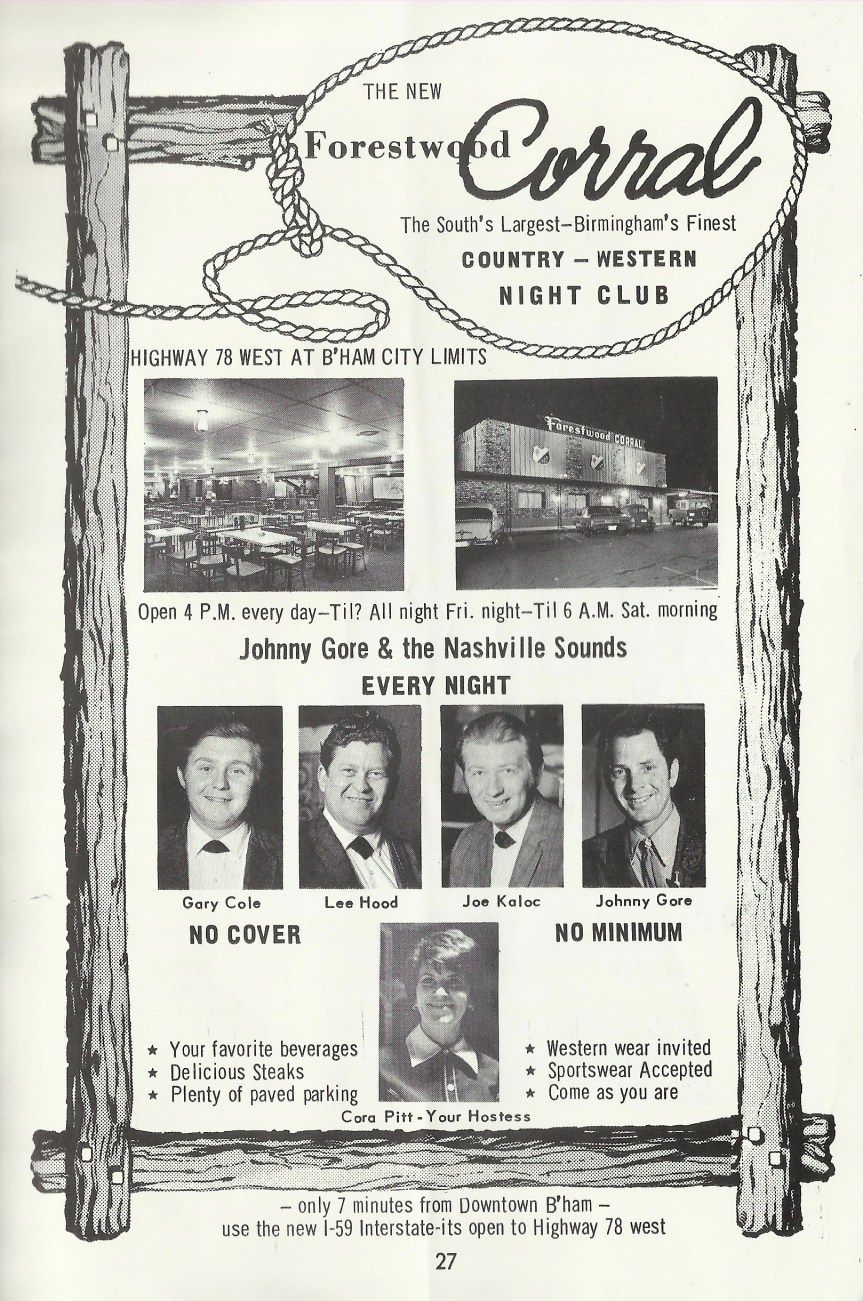
“Western wear invited. Sportswear accepted.” Happenings ’69.

I was working on my next couple of blog posts, “Adventures in Basements” (Parts 1 & 2), when I got a call from my friend Patrick. “Adventures in Basements” will chronicle my favorite discoveries rooting through archives and library stacks around the country. But in the meantime Patrick called to say he wanted to pass on to me a small but generous chunk of his own archival collection.

Over the course of a lifetime Patrick Cather has built an incredible collection of books, records, memorabilia, artifacts, and ephemera related to (among many other things) Birmingham’s history and music. We got to know each other several years ago through a mutual friend, Frank “Doc” Adams. My book-in-progress includes a lengthy, important chapter on Patrick, Doc, and the boogie-woogie pianist Robert McCoy.

About a year ago Patrick entrusted to me a couple hundred R&B and soul records, mostly from the 1960s. This week he shared with me enough 78’s to make my car sink from the weight: Bessie Smith, Jimmie Rodgers, Fats Waller, the Mississippi Sheiks, Erskine Hawkins, and all sorts of other things. There’s even one from Clifford Hayes’s Louisville Jug Stompers and a couple of the V-Disc records, issued during World War II for the soldiers overseas.

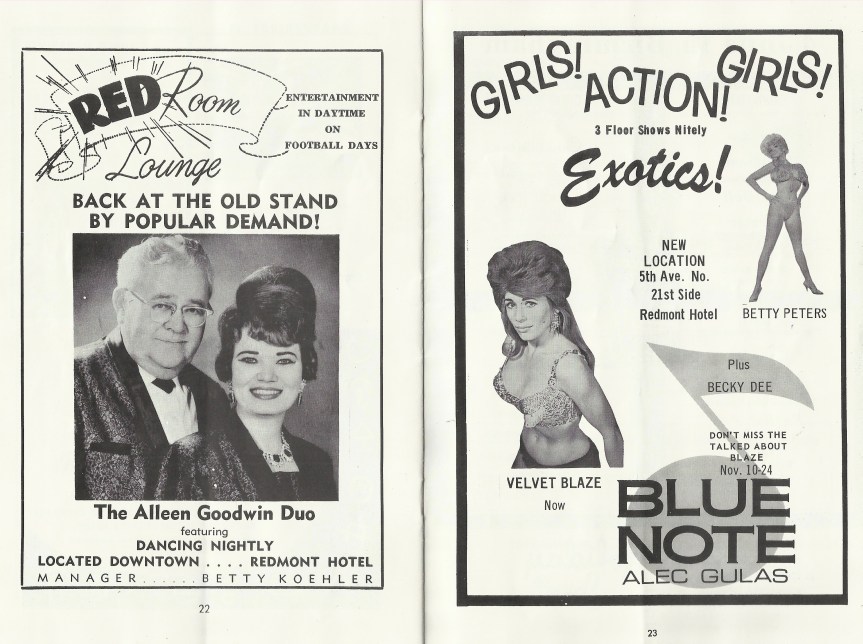
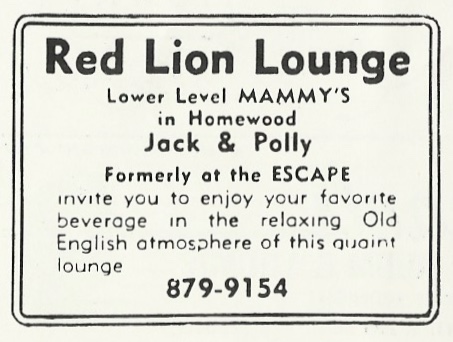
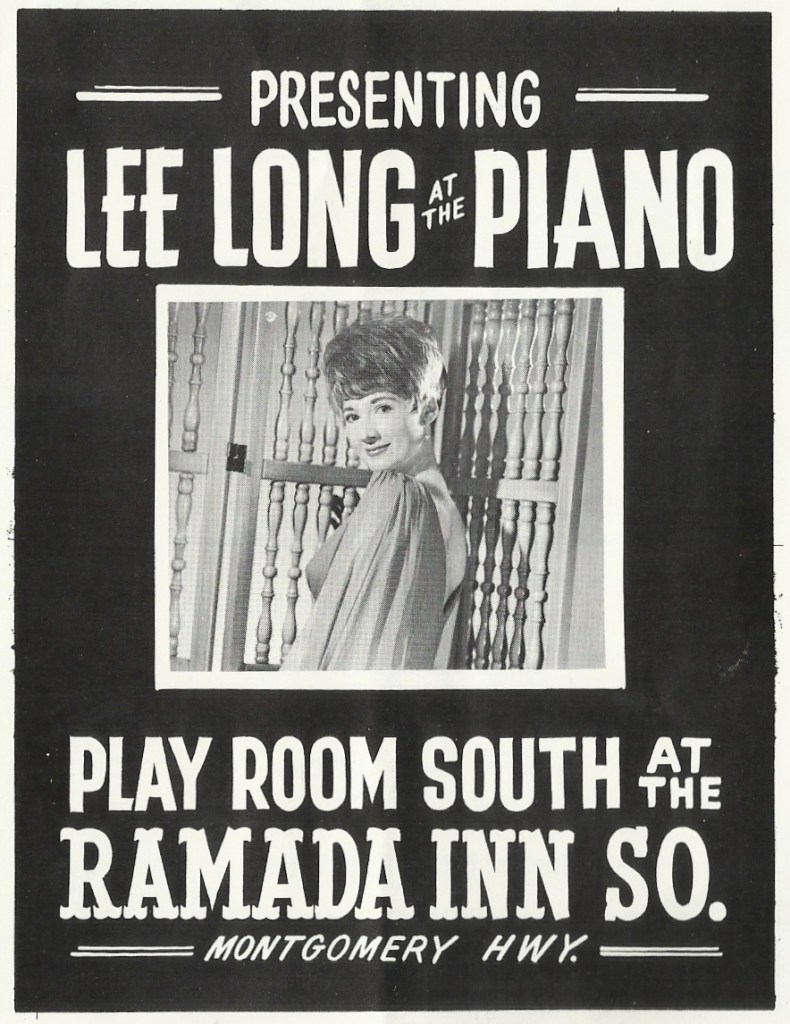
Among the papers I got from Patrick was a single issue of Dick Coffee’s Birmingham Doin’s, dated November of 1969. It’s a periodical survey of late 1960s (white) Birmingham nightlife, consisting mostly of advertisements. As such, it’s an interesting glimpse into this city’s nightclubs—a segment of them, anyway—a half a century ago.

I asked Patrick, flipping through the pages: Did you ever go to the Original Boom Boom Room?

Many times, he said, and added: the Boom Boom Room had a chicken in a cage, and it would dance on demand. 

Only one of the establishments listed below is still in business: the Red Lion in Homewood, a place I love. Long may it run.

I’ll be posting many more archival finds in the weeks ahead—including some excerpts from Glare magazine, the glossy 1950s magazine devoted to Birmingham’s black entertainment and social life. For now, here are some Birmingham Doin’s.

Don’t miss the talked about Blaze.

boom-boom-room

boom-boom-room-1

bham-girls

lee-long-at-the-patio

red-lion-2

lee-long-at-the-patio-4

forestwood-corral

Postscript:

While I was going through his records, Patrick got a call from the family of Joe Rumore, Birmingham’s late, longtime radio personality: a chunk of Rumore’s estate, it happened, was going on sale in the morning, and Patrick passed the tip along to me.

I went to the Rumore sale, but I only purchased one item. There were lots of framed, signed photos of old country music stars, all out of my budget—and autographed head shots don’t do much for me, anyway.  More my speed, and priced at just a few dollars,  was this photo from radio station WSPG in Anniston, Alabama: a trio identified as Mary Frady, Jerry Frady, and Ruby Fallon. I’ve got a decent collection of photos like this—images of forgotten, mostly anonymous musicians—and I find all the details in them wonderful. For starters: from a distance the pattern on Jerry’s shirt might look likes flowers, but it’s cowboys and lassos.

Version 2

Really I love everything about this photo. The mic placement, obviously. The rolled cuffs of Jerry’s pants. The younger woman and the older woman, and their symmetry. That fringe, just under their knees. How everybody’s wearing boots. The look on Ruby’s face. The look on Mary’s. Jerry’s absolute earnestness.

I’d like to have heard him sing.

(Incidentally, about this time last year I compiled some of my photos of “lost and found” musicians in a little collection, titled “Melodies Unheard.” You can get a copy here.

More soon.)

The Birmingham Sessions

img_3760

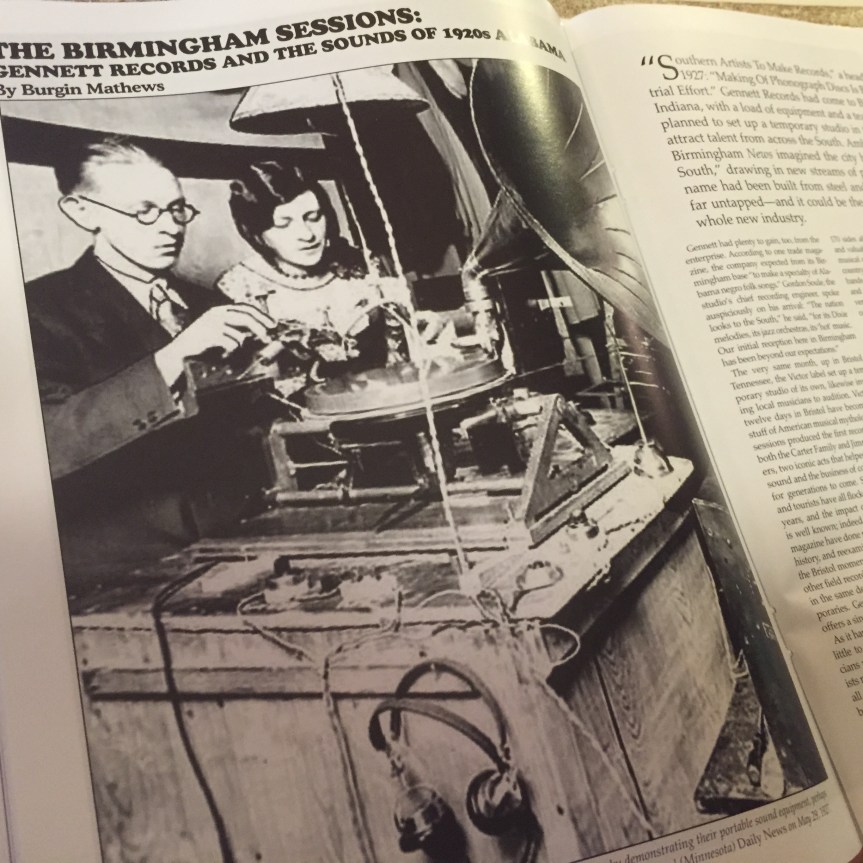
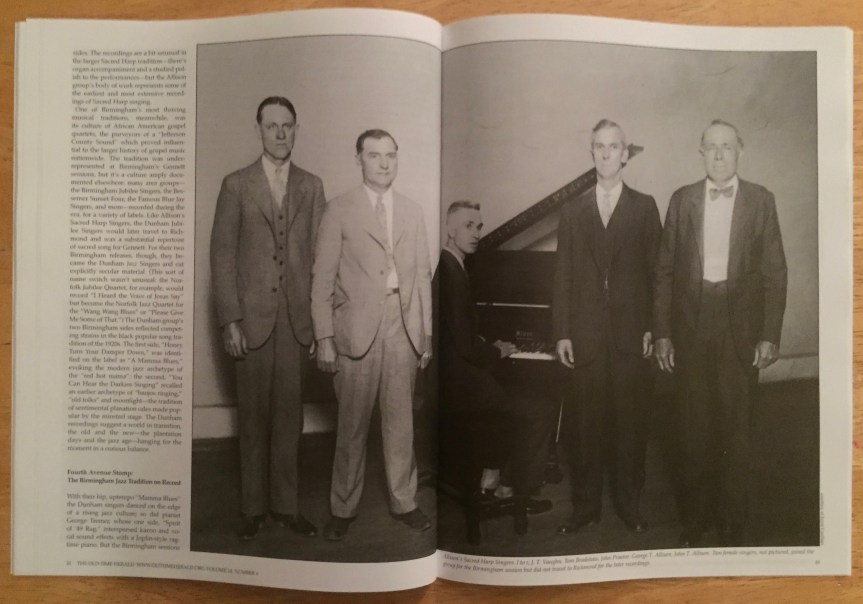
I’ve got an article in this month’s issue of The Old-Time Herald exploring Gennett Records’ 1927 trip to Birmingham. For two months the label set up shop in the Starr Piano store and waxed records of all sorts of local music makers: blues musicians, old-time string bands, jazz bands, Sacred Harp singers, society dance orchestras, gospel quartets, and more. The records, seldom heard today, offer a kind of cross section and time capsule of Alabama music as it sounded 90 years ago. My article dives into the specifics of these Birmingham sessions, placing them in the context of other “location recording” expeditions of the era—and takes a look at the many performers who came to the Starr store to record.

For many years, The Old-Time Herald has documented both the history and contemporary state of old-time string band music and other related traditions.They make room for long articles like this one, and they take great care with their photos and illustrations—as you can see in the spreads below. My article on the Birmingham sessions is a much-expanded version of a piece I published last summer in Birmingham magazine.

A quick excerpt follows. To read the whole thing, subscribe to the OTH. Thanks to the magazine’s editor, Sarah Bryan, for all her help—and to Joyce Cauthen for loaning some great photos, like the two below.

img_3761img_3763

From “The Birmingham Sessions: Gennett Records and the Sounds of 1920s Alabama”:

“Southern Artists To Make Records,” a headline announced in July of 1927: “Making Of Phonograph Discs Is Birmingham’s Latest Industrial Effort.” Gennett Records had come to Birmingham from Richmond, Indiana, with a load of equipment and a team of engineers. The company planned to set up a temporary studio in the Alabama city and hoped to attract talent from across the South. Ambitions were high all around. The Birmingham News imagined the city becoming “a musical center of the South,” drawing in new streams of profit and acclaim; in a town whose name had been built from steel and coal, music was a local resource so far untapped—and it could be the foundation, the papers imagined, of a whole new industry.

Gennett had plenty to gain, too, from the enterprise. According to one trade magazine, the company expected from its Birmingham base “to make a specialty of Alabama negro folk songs.” Gordon Soule, the studio’s chief recording engineer, spoke auspiciously on his arrival: “The nation looks to the South,” he said, “for its Dixie melodies, its jazz orchestras, its ‘hot’ music. Our initial reception here in Birmingham has been beyond our expectations.”

The very same month, up in Bristol, Tennessee, the Victor label set up a temporary studio of its own, likewise inviting local musicians to audition. Victor’s twelve days in Bristol have become the stuff of American musical mythology: the sessions produced the first recordings of both the Carter Family and Jimmie Rodgers, two iconic acts that helped shape the sound and the business of country music for generations to come. Scholars, fans, and tourists have all flocked to Bristol for years, and the impact of those sessions is well known […] Less familiar are the other field recording sessions conducted, in the same decade, by Victor’s contemporaries. Gennett’s trip to Birmingham offers a single case study.

As it happened, the Gennett sessions did little to advance the careers of the musicians who participated; most of these artists never recorded again. Birmingham, for all the newspaper’s excitement, wasn’t reborn into a mighty music hub. There were no game-changing discoveries, no Carters or Rodgers as there were that summer in Bristol. But the recordings made in Birmingham that July and August—nearly 170 sides altogether—represent a unique and valuable cross-section of the region’s musical culture. There are jazz bands and country blues singers, old-time string bands, gospel quartets, a ragtime pianist and singers of the Sacred Harp—a rich diversity of local sounds, all testament to a community steeped in music….

Happy Birthday, Doc

“I was born—they tell me I was—on Groundhog’s Day: February 2, 1928.”

This is how Doc Adams started our first interview together, one Saturday afternoon in August of 2008. We’d met only once before, but I’d been eager to meet him again. I’d told him I wanted to write an article about him and his music—he’d played with Sun Ra, Duke Ellington, and others and had been a mainstay of the Birmingham jazz community for years—and he agreed to an interview. I arrived with three pages of questions, none of which I got around to asking. The moment I turned on my recorder, Doc launched into his story, starting at his birth and proceeding chronologically from there, laying out his life in remarkable, loving, specific detail—describing, even, the tile on his parents’ living room floor, whose pattern he’d studied from infancy.

Doc had many gifts; just one of them was his power in storytelling. At the end of two hours, he was about to graduate from high school—and I’d abandoned my notebook of questions altogether. As the interview came to a close, he found a place to pause his reminiscence: with the letter of recommendation his early mentor Sun Ra (then still “Sonny Blount”) sent on his behalf to Howard University. It was an effective cliffhanger.

“We’re going to have to have another session,” Doc told me. I happily agreed and came back the next week. And the week after that. For two and a half years we did it again, every Saturday and occasional Sundays, until his story stretched out across a hundred cassette tapes. Eventually I started asking questions. What was going to be an article turned into a book—and, more than that, a life-changing friendship.

Doc died in 2014. For his birthday today I’d like to share this remembrance I wrote after his death for the weekly paper Weld. Of all the things I’ve ever written, this is easily the most meaningful to me. I hope you’ll click the link below to read the full story—and join me in remembering Dr. Frank Adams, with gratitude and love, on this, the anniversary of his birth.

Happy birthday, Doc.

doc-by-jessica

Remembering “Doc” Adams
November 11, 2014 // WELD for Birmingham 

Like a lot of people, I knew Frank Adams most of all as “Doc,” but over the course of an extraordinary life he went by a variety of names. To many among his friends and family he was first and foremost “Frank,” and to years upon years of students at Lincoln Elementary he’d always be “Mr. Adams,” the much-loved teacher and role model.

As a high school student in the ‘40s, he traveled with comedian Mantan Moreland’s Hot Harlem Revue, and Moreland dubbed him “Juniflip,” a name for the young and unpredictable, the energetic but untested. (“You’re just a little Juniflip,” Adams liked to explain in later years: “You might flip over into greatness, or you might flip back into mediocrity.”) Other, older musicians in those days knew him as “Youngblood.” In college at Howard University, his bandmates called him “Francois” — a name which they on some occasions extended to Francois DeBullion (“I never knew where they got that DeBullion,” he said), but which on other occasions, as he launched into an especially hot solo, they might abbreviate to just “’wa.”

“Get it, ’wa!” they’d shout from the sidelines, and — as he’d do from many stages, for many decades to come — he’d get it.

He had an insatiable appetite for education — his students’ education, of course, but also his own — and so he pursued a series of degrees, culminating in the one that made him “Dr. Adams.” The title suited his role as gentleman and scholar, but he shook loose its stifling formality every opportunity he got.

“Please,” he’d plead, “just call me Doc.”

Click HERE to read the rest of this article…

P.S. We are lucky that one of Doc’s students, Jessica Latten, documented his spirit so beautifully in her photographs. The photo on this page is hers; others are included in the Weld story, and she’s taken many(!) more just as good. Thanks to Jessica for sharing these loving portraits of a man whose memory means so much to so many.

Table(s) of Contents

I said when I started this blog that one big purpose of the site was to complement my book in progress, my history of Birmingham jazz. I promised to share updates and outtakes, excerpts and footnotes, and to shed some light on the daily(ish) struggle of getting this thing onto paper, and (eventually) out to the world.

I haven’t posted a word about the book since then, so I thought I’d finally get to it today—and a table of contents seemed like a good, simple place to start. Sooner or later I’ll tell you more about why I’m writing this book, why I think the story’s so important, and what the overall gist of it is. In short, for now, it’s the story of how the unlikely city of Birmingham, Alabama helped shape the world of jazz—and of how jazz helped shape the city of Birmingham.

It’s a story that, for the most part, just hasn’t been told—at least not widely. People here in Birmingham don’t know it; neither do jazz lovers elsewhere. The book covers more or less a full century, revealing how the music programs of the city’s segregated black schools became a training ground for legions of jazz sidemen, arrangers, and a few notable bandleaders. I explore how a unique tradition of jazz musicianship helped generations of local players craft identities and experiences that transcended the limitations of the Jim Crow South—and examine how Birmingham players contributed actively, if largely from the sidelines, to the national culture of jazz. At the heart of the book is the swing era of the 1920s, ’30s, and ’40s, but we see also how Birmingham helped beget bebop—and how one Magic Citizen, the iconoclastic, otherworldly Sun Ra, pushed jazz to its furthest limits, even as he drew from his own Birmingham roots.

My working table of contents follows. The chapter titles may be a little cryptic on their own; my notes in the margins add a little bit of detail, but a table of contents is inherently a sort of tease. All but two of these chapters exist in some form now, though some are  further along than others. The book title you see here—Magic City Bounce and Swing—is one I intend to discard once I finally find something better. I’ve been brainstorming for a few years now and for the life of me can’t come up with a title I like. I’ve searched song lyrics and quotes for the right phrase, and I keep coming up with nothing. I invite your title suggestions in the comments.
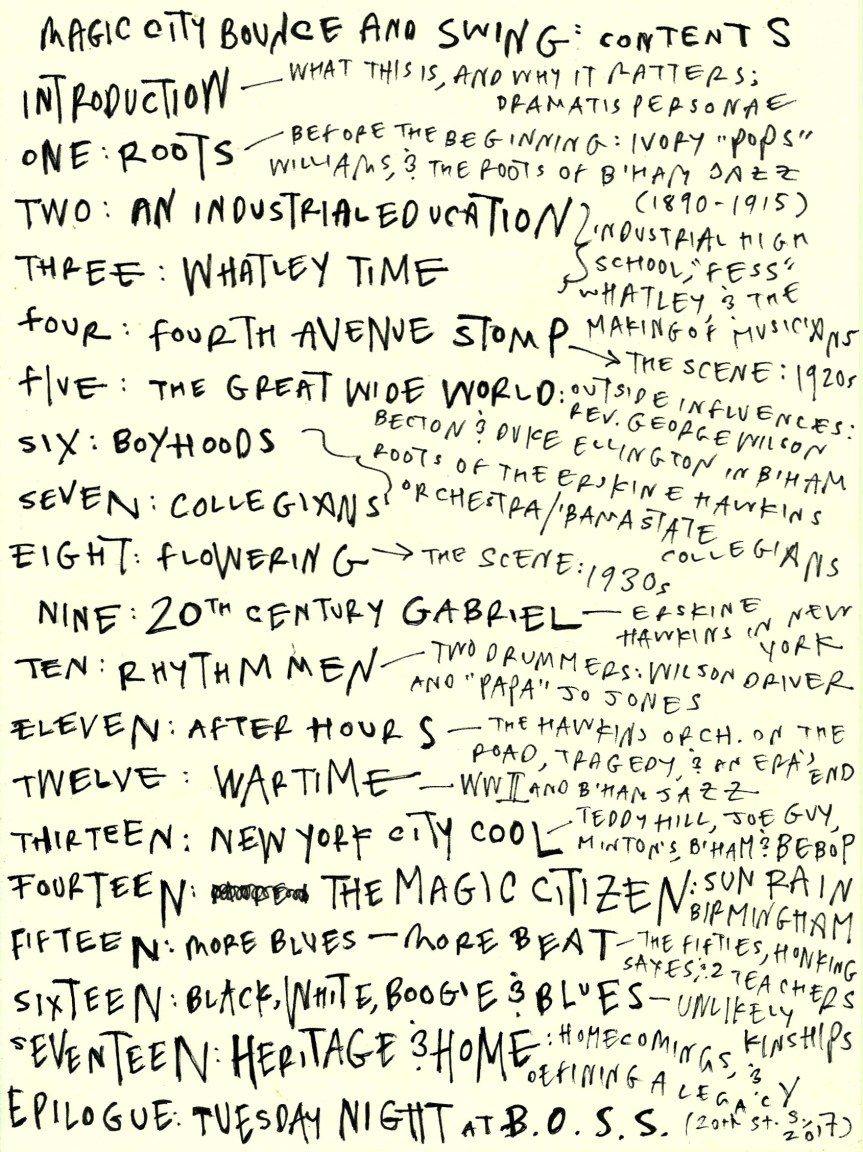
table-of-contents

*

While we’re on the subject, an aside:

I spend a lot of time making lists of things, and the lists I’ve always enjoyed making most seem to be tables of contents. When I was a kid I was always making little books and filling them with stories, and always kicking them off on page one with a handy table of contents. I recently came across a little blank book my mom brought me home from the drugstore once, which I filled with two tiny novels: “Who’s Who?” and “The Christmas Mess.” It’s signed and dated 1988, so I guess I was eleven. It’s a pretty ambitious work, and it starts, of course, with a table of contents. For “Who’s Who” the TOC reads:

  1. Wadsworth – 1
  2. Spies – 9
  3. The Switch – 17
  4. Problems – 23
  5. Vampire Bob – 41
  6. Trouble – 47
  7. The Plan – 53
  8. Goodbye, Spies – 59
  9. Pop’s Diary – 63

Who wouldn’t want to read on, after that promise of things to come?

By seventh grade I was filling up notebooks and floppy discs with more tables of contents for more books I wanted to write or was secretly writing. In seventh and eighth grade I discovered real, written comedy: somehow before the internet ever happened, I’d managed to get my hands on copies of Monty Python’s two original Flying Circus books, published in the ‘70s, and Steve Martin’s absurdist collection Cruel Shoes, as well as The Complete Prose of Woody Allen, a compendium of Without Feathers and Getting Even and Side Effects. (I remember the Woody Allen book was on the sale table at Walden Books at the Montgomery Mall for $7.99 in a massive hardback, and I got a beat-up little blue and tan copy of Cruel Shoes at Montgomery’s one used-book store (that’s where I got Woody Guthrie’s Bound for Glory, too—see a previous post about that). I don’t know where I got the Monty Python books, maybe from a Signals catalogue or something similarly nerdy.)

Needless to say, my tables of contents reflected what I was writing, which reflected what I was reading: so in those days it was short, absurdist sketches and and silly comic essays. Every time I produced a few new pieces, I’d rearrange it all with a new table of contents.

In high school I discovered seriousness and poetry and I wrote many more tables of contents, outlining both my current writings and my future, unwritten—but carefully outlined—ambitions.

There were other tables, to be sure, in the years that followed. But jumping ahead to the table at hand:

Frank “Doc” Adams and I published our book Doc in 2012, and some months before it was done I wrote out my first table of contents for the book I’m writing now, the book outlined above. I’ve tweaked and rewritten this table of contents a million times. The contents and sequence have changed very little since I first charted it out: as the project has grown some chapters have split into half, or into three, but the overall flow sticks close to my initial conception. Sometimes I have to remind myself that rewriting the table of contents in my notebook, with minor adjustments, does not constitute writing, does not make a day’s work. Sadly, frankly, it’s on some days all I can do. Its’ tempting to let list-making stand in for true creative productivity; I remind myself often to resist the urge.

I might add this uncomfortable confession: that writing this book for so long I finally appreciate—I mean really appreciate—The Shining, a movie I’ve always loved but never before thought relatable. It’s not a happy revelation. I image Glory, horror-stricken, flipping through pages and pages of what I’ve written so far and discovering it’s all the same thing, over and over again. The same table of contents, the same chapters, the same sentences, revealing in their endless repetition my descent into madness. All work and no play… My own stomach sinks when I pick up my latest print-out: haven’t I typed out and held these words in my hands a thousand times already? I flip through my notebooks and find uncountable iterations of the same basic sequence and titles: IntroductionRootsAn Industrial Education 

I do make progress, though, little by little. And I stand proudly by my table—as the contents themselves slowly catch up to its promise.

(In the meantime, please: somebody send me a title.)